



This article was originally published as a Boundless newsletter. New issues arrive every Sunday.
Hi Friends,
Today we're going to chat about the steel of the Theodore Roosevelt Presidential Library.
As you scroll through this issue, watch how each phase of the construction process depended on the one before it. Nothing here happened in isolation. Concrete couldn't happen without the dirtwork, steel couldn't happen without the concrete and mass timber couldn't happen without the steel.
Today you'll see a lot of TrueNorth Steel out of Mandan, ND, who fabricated the structural steel, and Innovative Builders out of Alexandria, MN, who spent seven months on site putting it all together.
Let's dig in.

Ironworkers guide a steel beam into position against the concrete auditorium wall. May 2024. All images © Chad Ziemendorf.
Structure
Over the past several issues, I've taken you through the progression of materials that are bringing this building to life. The dirtwork prepared the ground. The concrete gave it walls, foundations, and anchors. Now, the steel gives the Theodore Roosevelt Presidential Library its structure.
Steel's role on this project was specific. The concrete had already created significant structures - retaining walls on the east side, the auditorium toward the center, a massive staircase frame on the west. But even though those elements provided significant load-bearing assistance, they were separated. The steel is what connected them. It provided the vertical columns and the horizontal spans that bridged the gaps between the concrete, creating the open volumes and the framework that the rest of the building would depend on.
And what comes afterwards depends on the steel entirely. The mass timber that will give the interior its warmth and create the entirety of the roof deck threads directly through the steel framework. Without the steel in place, the timber has nothing to attach to.
Each material on this project has its moment before it becomes the foundation for the next material. This is steel's moment.
But before they could place the first beam, they had to get a crane up the hill.

The first heavy-lift crane arrives in Medora and makes its way up the hill to the job site. March 2024.

The driver of the transport truck releases the safety chains that secured the crane to the trailer prior to unloading it. March 2024.

The heavy transport driver walks the trailer after the climb. March 2024.

The first heavy-lift crane makes its way onto the job site after being unloaded. March 2024.
First, You Need a Crane.
On March 29, the crane arrived in Medora.
It came on a custom trailer with multiple axles and articulation points designed to distribute the weight across the road surface and navigate tight turns. The rig was massive. And the road from town to the construction site is steep and winding.
The driver parked at the bottom of the hill and previewed the full route first with Mike Murphy. He scouted every turn, studied the incline, identified exactly what gear he needed and what speed to hold so he could maintain that chosen gear through each section of the climb. Multiple axles on a trailer that size require precise speed management on a grade - too fast and you overshoot your turns, too slow and you lose the momentum you need to keep moving uphill under that kind of load.
The math was simple. If the driver went off the road, tipped the load, or got stuck, there was no equipment in the area large enough to recover him. He was carrying the only thing big enough to lift itself. There was zero room for error.
He was dialed in. The crane was huge. The narrow winding road was steep. He made it look routine.

The first steel column is set on April 8, 2024.

Innovative Builders connecting the first beams to columns. The Badlands and the scale of the concrete work below came into full view from up on the retaining wall. April 2024.
April 8, 2024.
Ten days after the crane arrived, the first steel column went into place.
For anyone unfamiliar with the process, steel assembly follows a general sequence. Columns go in first, establishing the vertical grid. Then beams span between them horizontally, creating the floor and roof planes. Bracing and connections lock everything into a rigid frame. On a conventional building, many of these members are standard profiles - I-beams, wide flanges, hollow sections - cut to length and bolted together at predictable angles.
The TR Library is not a conventional building.
Snøhetta designed its structure with sweeping curves inspired by river pebbles and a leaf from the Little Missouri. The building's curved form doesn't come from curved steel. It comes from straight beams meeting at precisely calculated angles - hundreds of unique connection points, each one slightly different from the last, collectively creating the illusion of a continuous curve from end to end.1
That meant no standard assembly. Every connection had to be planned, fabricated, and installed in a specific sequence. Innovative Builders started putting it together not much different from the way you'd assemble a LEGO set - piece by piece. Just a lot bigger, a lot heavier and a lot more dangerous.

One of the early steel delivery trucks arrives onsite. April 2024.

The first steel beams from TrueNorth Steel staged on site. April 2024.

Innovative Builders taking inventory shortly after the first delivery. April 2024.
Made in Mandan.
The structural steel was fabricated by TrueNorth Steel at their facility in Mandan, North Dakota - roughly 130 miles east of the construction site in Medora.2
TrueNorth Steel is a family-owned company, now in its third generation, with over 80 years of history building steel infrastructure across the region. They've fabricated bridges, tanks, and commercial structures for decades. But this project carried a different weight.
At the topping out ceremony in August 2024, JE Dunn's project manager Trever Leingang said of TrueNorth: "I don't think there could have been a better company to be a big part of the project."3
A North Dakota company, fabricating steel for a North Dakota landmark. When the ceremony arrived, the entire Mandan production team made the drive to Medora to be there. They signed the beam they helped fabricate before it was raised into place.3

The specialized steel structures hang over what would eventually be the library's auditorium. The hole in the concrete is the window projector room. May 2024.

Applying fireproofing material to the steel columns. August 2024.

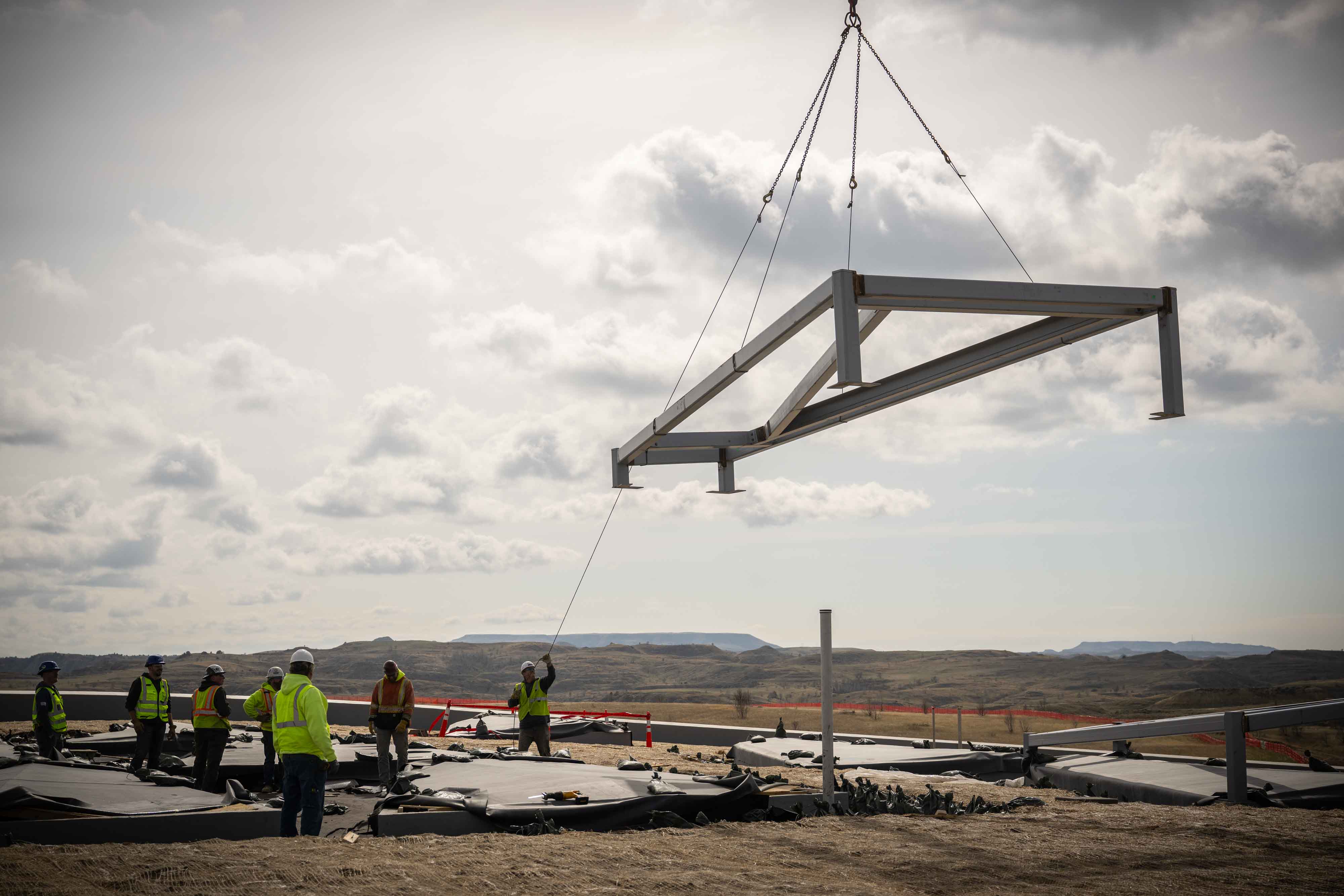
A beam assembly swings into position above the auditorium. May 2024.

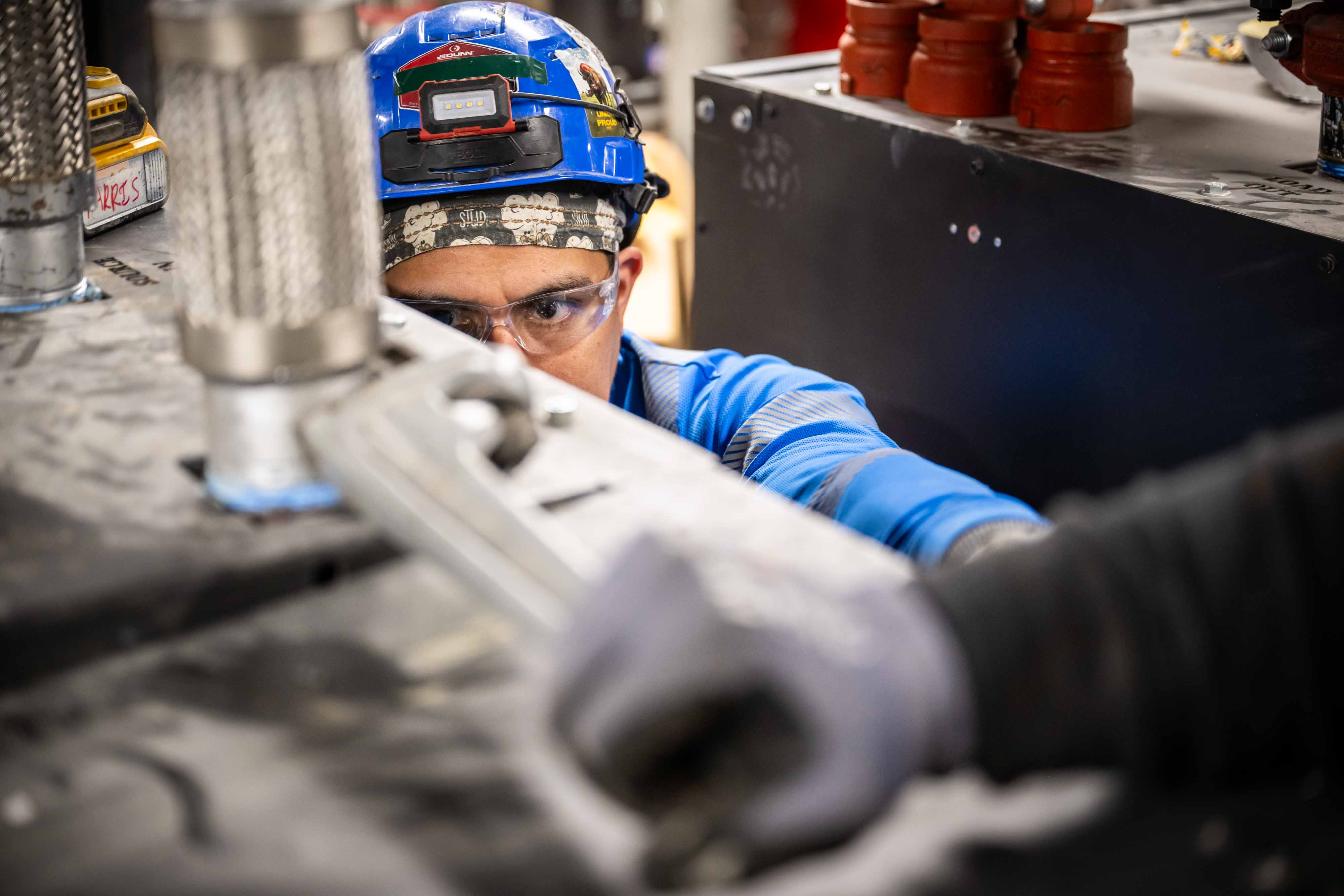
A welder works inside the steel framework as the building takes shape around him. May 2024.
No Two Alike.
Before TrueNorth Steel could fabricate a single beam, every connection had to be modeled in precise detail. Anatomic Iron Steel Detailing produced the drawings and 3D models that translated the architects' curved design into fabrication-ready specifications - hundreds of unique connections, each one engineered for its exact location in the building.
Every beam in this building was custom fabricated for one specific location.1 Each one designed to meet its connection points at the precise angles required by the roof's geometry. No catalog pieces. No standard cuts. If you pulled a beam out of one position and tried to install it somewhere else in the same building, it would not fit.
This is precision fabrication at a scale most people never see. And the building it's all going into sits in a town of 160 people in western North Dakota.
I think I heard that two of the steel columns might be identical, but like Steve Fore from JE Dunn says, "Just don't ask me which two."
Enjoying this? Boundless is a free weekly newsletter delivering behind-the-scenes documentation of the Theodore Roosevelt Presidential Library, plus reflections on what vast landscapes teach us about peace, resilience, perspective, and renewal.
Subscribe here → to get the next issue delivered to your inbox every Sunday.

Rigging a beam for the crane. May 2024.

Watching as the beam swings into place overhead. May 2024.

An ironworker tightens the bolts on a newly-placed beam as spud wrenches poke through from the other side to help hold it in place. May 2024.

A welder lifts his mask in between welds as he sits on top of one of the beams with the Badlands stretching out behind him. August 2024.
The Crew From Alexandria.
TrueNorth Steel fabricated the steel. Innovative Builders, out of Alexandria, Minnesota, installed it.
They were the face of the steel phase during all of my visits. From April through November of 2024, Innovative's crew was on site putting this framework together piece by piece. Seven months of cranes swinging custom beams into position, ironworkers guiding steel with hand signals at height, every member threaded into a framework where no two connections were the same.
On a building with standard geometry, steel installation is already demanding work. On a building where every connection point is a unique angle, the margin for error shrinks considerably. These crews brought precision to a structure that required it at every joint, in a remote location with weather and wind that doesn't care about your schedule.

A welder connects a joint on one of the beams from high up in his boom lift. May 2024.

A beam swings into position above the western concrete wall, the Badlands stretching out behind it. August 2024.

A custom prefabricated steel skylight frame is lowered onto the roof. April 2025.
Zero.
One number from the steel phase that deserves its own section.
Throughout the entire production and structural steel erection, there were zero accidents and zero injuries.3
Custom steel. Unique angles at every connection. A remote site. Workers at height every day for months. And nobody got hurt.
Safety records don't make architectural magazines. But they mean people went home to their families at the end of every shift. That matters on every job site. On this one, it feels especially right.

Governor Doug Burgum at the beam signing ceremony. August 2024.

The signed beam rises. August 2024.

The signed beam in place. September 2024.
The Beam Signing.
On August 14, 2024, with the steel framework well underway, the Theodore Roosevelt Presidential Library held its beam signing ceremony. It was part celebration, part milestone marker, and part excuse to get everyone who cared about this project into the same place at the same time.
There's a long tradition in construction of signing a beam before it goes up. The people who built it, designed it, and funded it write their names on it as a way to permanently affix their fingerprints to the project forever. This was that day.
Craig Dykers, founding partner of Norwegian architecture firm Snøhetta, attached an evergreen branch to the beam, an ancient Scandinavian custom of respect toward the natural world a building displaces. On a building his firm designed, for a president whose legacy is rooted in conservation, his gesture especially resonated.
Ed O'Keefe, the library's CEO, stood before the crowd and quoted the building's namesake: "Theodore Roosevelt said, 'Believe you can and you are halfway there.' Folks, we are halfway there."4
Governor Burgum signed the beam. Both senators spoke. Theodore Roosevelt's great-great-grandson was there.
Senator Kevin Cramer looked at what the steel had become and said: "So much of construction and development replaces nature with a structure. In this case, they've built a structure into nature, and that tells the story of Theodore Roosevelt so beautifully and with such integrity."5
I got to sign the beam too.

An aerial view of steel, timber, and concrete working together. August 2024.

The steel framework from above, early in the process. May 2024.

A skylight frame staged on the ground, moments before the crane takes it to the roof. April 2025.

Securing the rigging before the lift. April 2025.
The Relay.
What stands out to me about this project isn't any single material. It's the progression.
The dirt became the platform for concrete. The concrete became the platform for steel. And the steel is now becoming the platform for mass timber. Each element performed at its highest level during its moment, then stepped back to become the foundation for whatever came next.
No single material could build the Theodore Roosevelt Presidential Library alone.
That's true in construction. It's also true in most things worth building.

Mass timber meets steel. The glulam beams and CLT panels thread through the steel columns, and if you look closely, every connection point between the two materials tells its own story. August 2024.
Next Week
The steel gave this building its skeleton. Next week, Mercer Mass Timber and the crew from Seagate give it warmth and continued structure. Over 1,800 cubic meters of engineered wood, threaded through the steel framework that Innovative Builders spent seven months assembling.
See you next Sunday.
Chad Z.
Want More Like This?
If you appreciate this level of landmark project documentation, or if you're drawn to what vast landscapes teach us about peace, resilience, perspective, and renewal, Boundless might be for you.
New issues arrive every Sunday.
References
- Theodore Roosevelt Presidential Library, "Starting to Take Shape," trlibrary.com, 2025.
- TrueNorth Steel, "Building History at the Theodore Roosevelt Presidential Library," truenorthsteel.com, July 2024.
- TrueNorth Steel, "TrueNorth Steel Celebrates Milestone at Theodore Roosevelt Presidential Library Topping Out Ceremony," truenorthsteel.com, August 20, 2024.
- Ed O'Keefe, quoted in North Dakota Monitor, August 14, 2024.
- Senator Kevin Cramer, quoted in North Dakota Monitor, August 14, 2024.
Boundless is the weekly newsletter of photographer Chad Ziemendorf. Each issue explores what vast landscapes and landmark human endeavors teach us about peace, resilience, perspective, and renewal.
All content and images © Chad Ziemendorf. All rights reserved.
Share:
Boundless No. 00004 // An Exhale For Your Soul
Boundless No. 00006 // The Photo Advice That Changed My Craft Forever