



Hi Friends,
Last week we talked about the dirt. This week: concrete.
Before the steel. Before the timber. Before the glass. The concrete was there first - holding it all.
Fair warning: this issue turned into an unintentional tribute to Winn Construction. They didn't ask for it, they earned it. When you repeatedly pour concrete on the same project for two years, you tend to show up in the photos.
Let's dig in.


The first concrete pour at the Theodore Roosevelt Presidential Library. Winn Construction crews prepare the foundation forms. August 2023. All images © Chad Ziemendorf.
In August 2023, Winn Construction poured the first concrete at the Theodore Roosevelt Presidential Library.
It was not ordinary concrete.
The mix was developed specifically for this project - a low-carbon formula using fly ash and slag to replace a significant portion of the traditional cement. The result: roughly half the carbon footprint of a standard pour.
Dickinson Ready-Mix, a local supplier, worked with engineers to develop the formula. North Dakota concrete, mixed for a North Dakota project, optimized with the same level of intention as everything else on this project.

Rebar at the ready before the first concrete pour in August 2023.

Workers look on as the first concrete flows through the pump truck hose and fills the forms. August 2023.

An overhead view of the first concrete pour progress in the footings of the west building. August 2023.
I remember that first pour clearly.
There was a unique energy on site that day. A heightened sense of anticipation. After months of earthwork and preparation, the first structural elements were finally going into the ground.
Watching the concrete flow through the pump truck hose and fill those forms felt like a moment of celebration. Everyone knew what it meant. This project was no longer just a good idea. It was a landmark becoming tangible.
Over the next two years, I would photograph thousands of yards of concrete installation. Retaining walls. Roof decks. Gallery floors. Parking lots. But this one stood out.
First pours always do. They're the line between planning and permanence.

A view from inside the rebar of the western-most wall as a worker ascends in his man-lift to make final preparations before the concrete pour. September 2023.

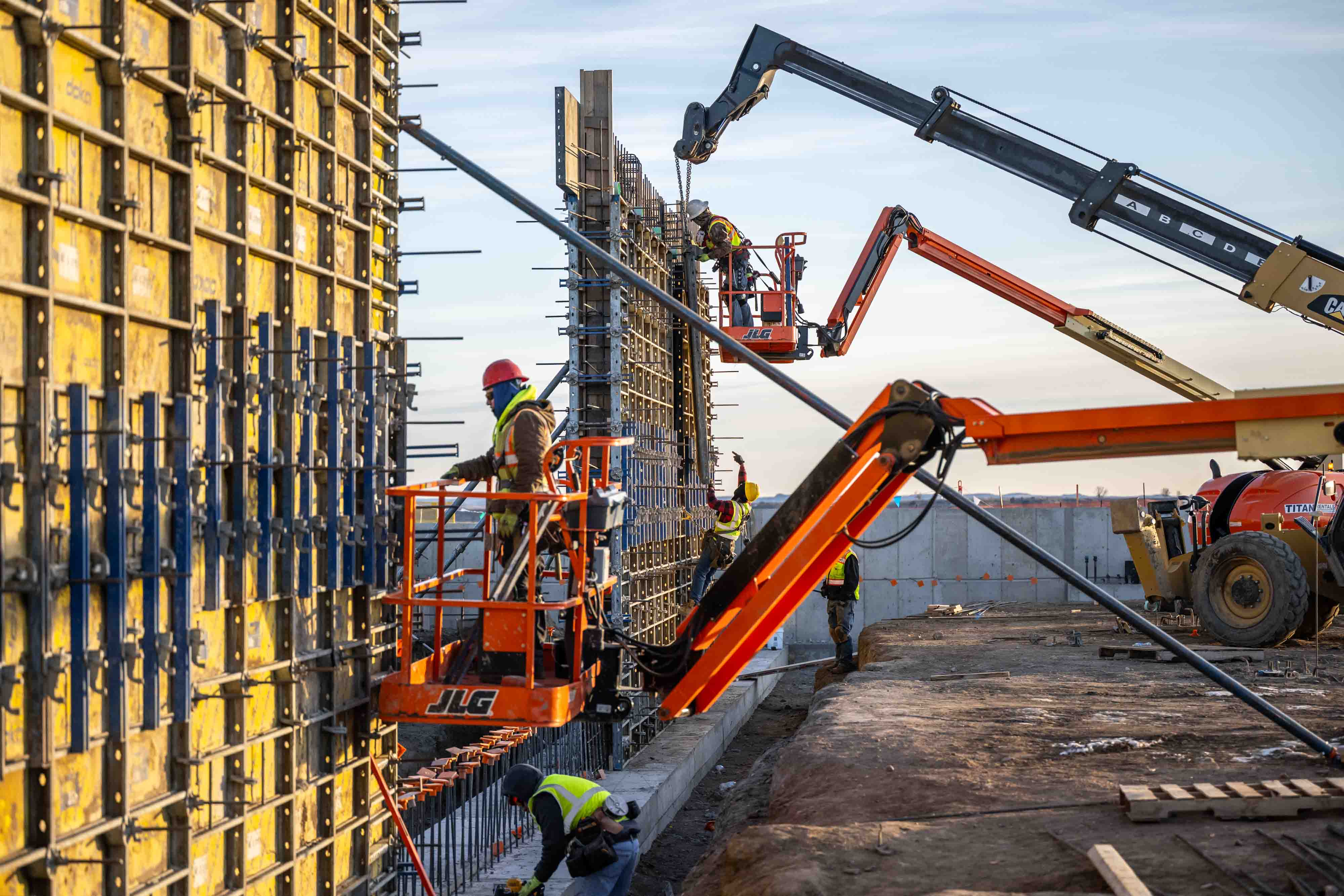
An elevated view from a man-lift of the giant retaining wall concrete forms. September 2023.

A worker signals to the team below for a tool to secure the next section of concrete forms. September 2023.
The eastern retaining wall and western perimeter wall required hundreds of yards of concrete - a succession of massive pours that would anchor the building's relationship to the bluff.
Retaining walls do exactly what the name suggests: they retain. They hold back the earth. They create the terraced landscape that allows a building to nestle into terrain rather than dominate it.
This eastern retaining wall would eventually disappear behind the finished structure and be back-filled with dirt and some mechanical elements. No one will see it. But without it, nothing else works.

Winter concrete pours in western North Dakota. The work doesn't stop. December 2023.

A worker checks a level to ensure the rebar is vertical. December 2023.

Sunrise over the site. Heated blankets protect recent pours from freezing temperatures. December 2023.

Measuring the distance between rebar. Precision that will be buried but not forgotten. December 2023.

A December pour with blankets staged and ready. Timing matters when concrete meets cold. December 2023.
Western North Dakota winters are not for the timid.
Temperatures usually drop below -20°F. Wind chills push it lower. Some construction projects need to pause until spring. While the last two winters have been favorably mild for construction, there still have been some chilly days.
Concrete curing is a chemical reaction that requires heat. Pour in freezing conditions without protection, and the water in the mix freezes before the cement can hydrate. The result is weak, crumbly, useless.
The solution: heated blankets, careful timing, and workers willing to do precision work in conditions that make every movement harder.

A Braun Intertec technician fills sample canisters for testing. Temperature, strength, consistency - verified before the pour cures. February 2024.

Four workers chase the pour with hand trowels, finishing in close succession. February 2024.
By February 2024, the foundation work had expanded across the site. Each section of the building required its own carefully engineered footings - designed not just for structural loads but for the specific soil conditions of this place.
Remember the bentonite clay from last week? The same geology that makes this landscape so unusual also makes it challenging to build on. The foundations had to account for soil that swells when wet and contracts when dry.
Engineering for the earth, not against it.

Sunrise through the auditorium structure. The concrete skeleton awaits its skin. April 2024.
By April 2024, the auditorium structure had risen far enough to catch the morning light.
This image is a subtle favorite of mine. The concrete skeleton silhouetted against the Badlands sunrise as seen from across the breezeway - a building becoming, not yet arrived. And a magical moment that I got to witness knowing that as soon as the perimeter walls were in place, it will never again be duplicated.
The auditorium will host lectures, films, and public programs. It will be a gathering place for ideas about citizenship, conservation, and leadership. But in April 2024, it was still just potential. Steel and concrete waiting for purpose.
Enjoying this? Boundless is a free weekly newsletter delivering behind-the-scenes documentation of the Theodore Roosevelt Presidential Library, plus reflections on what vast landscapes teach us about peace, resilience, perspective, and renewal.
Subscribe here → to get the next issue delivered to your inbox every Sunday.

A worker measures for steel plate placement - an anchor point for a future beam. Crisp April sunrise. April 2024.

Workers on multiple lifts connect concrete forms like sophisticated LEGO creations. April 2024.

The pour, the next afternoon. April 2024.
Concrete doesn't shape itself. Every curve, every edge, every surface texture is determined by the forms it's poured into.
The formwork for this project was not simple. Snøhetta's design called for curves and angles that required custom fabrication. Standard plywood wouldn't do.
What you see here is the preparation for one of the major structural walls - forms set with precision, braced against the pressure of wet concrete, ready to receive thousands of pounds of material that will cure into something permanent.
The forms come down. The wall remains.

Setting the rebar grid on the future living roof deck. A mason's line ensures precision across the expanse. August 2024.
By 2024, the work had moved upward.
The living roof - the same surface that would eventually receive the preserved topsoil from Issue 002 - required its own concrete deck. Before that deck could be poured, the rebar had to be set.
This worker is using a mason's line to ensure the steel grid maintains the roof's designed curve. On a surface this large, small deviations compound. The line keeps every section true to the arc.
Precision work, holding the curve.

The pump boom reaches across the roof surface. October 2024.

Hand-finishing the roof deck concrete. October 2024.

The boom arm delivers concrete at sunrise as workers smooth the pour with a mechanical screed in the background. October 2024.
The roof deck pours happened in the back half of 2024 - varying temperatures, varying wind, still demanding.
Concrete pumps extended their booms across the surface, delivering material to crews who spread and leveled it by hand. The work moved fast. Concrete waits for no one. Once the pour begins, you finish or you lose it.
This deck would eventually support thousands of pounds of growing medium, native plants, and visitors walking the rooftop path. But first it had to cure. First it had to hold.

Hand-finishing concrete in one of the first-floor gallery areas. January 2025.
Not all concrete work happens where visitors will go.
The administrative areas - offices, workrooms, back-of-house spaces - required their own pours. These floors will support the people who keep the library running long after the cameras leave.
This worker is hand-troweling the surface in one of those spaces. Same precision. Same care. Whether the floor sees a thousand visitors a day or a handful of staff.

The masonry crew fills cinder block cores with grout. Structural work that will be hidden behind finished walls. March 2025.
Concrete takes many forms.
Here the Hardscapes Plus crew fills the cores of cinder blocks with grout - strengthening walls that will protect mechanical elements. This work won't be visible in the finished building. It will be behind drywall, behind finishes, behind the surfaces visitors actually see.
But it will be holding things up. Quietly. Permanently.

Workers pouring concrete floor in main gallery space. March 2025.

Worker smoothing gallery floor concrete with long-handled finishing tool. March 2025.
The main gallery floors went down in April 2025. Large pours that required coordination between multiple crews - concrete trucks arriving on schedule, pumps positioned, workers ready to spread and finish before the material began to set.
These are the floors visitors will actually walk on. The ones beneath their feet as they encounter Roosevelt's life, his presidency, his legacy. Every step supported by work done in a single day, two years before opening.

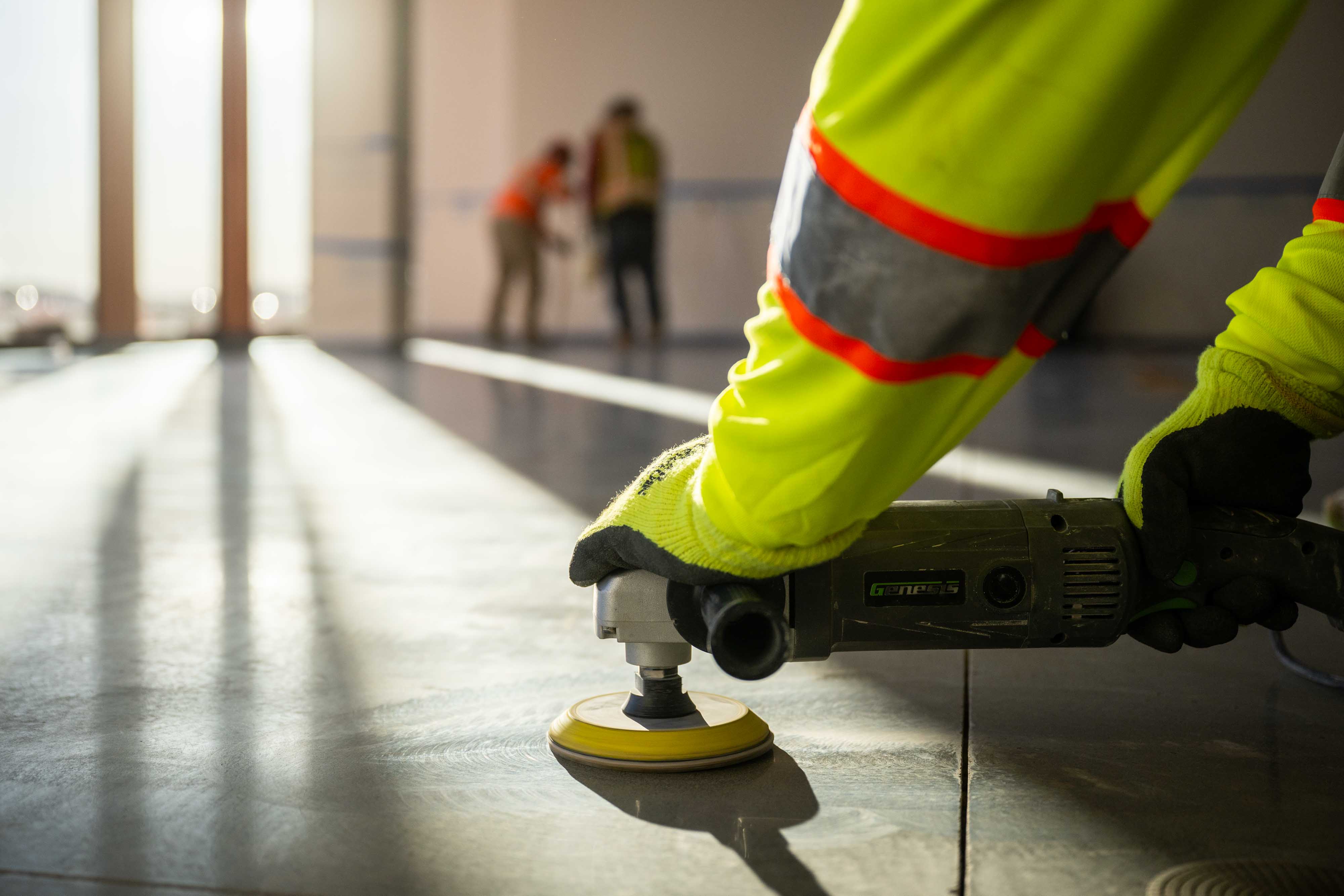
A worker grinds down the concrete edgework along the rooftop walkway walls. April 2025.
By June 2025, some areas of the work had shifted from pouring to finishing.
The rooftop walkway will guide visitors across the living roof, offering views of the Badlands in every direction. Before the tile could be laid, the concrete beneath it had to be perfect.
Here, a worker grinds the edges where forms met concrete - removing high spots, preparing the surface for the finish to come. It's detail work. The kind of task that separates adequate from excellent.
Details that seem small. Details that matter.

Winn Construction crews pour the visitor parking area. April 2025.
The building structure itself was nearly complete by July 2025. But concrete work continued.
Visitor parking. Service areas. The countless surfaces that support a building's operation without being part of the building itself. Winn Construction - the same crew that poured the first foundation in August 2023 - was still on site, still pouring, still doing the necessary work.
From first foundation to final parking lot: nearly two full years of concrete.

Concrete pylons dot the hillside, waiting for the steel bridge that will connect one of the boardwalk's most dramatic sections. The library rises in the background. June 2025.
The 1-mile boardwalk loop extends from the library into the surrounding terrain, connecting to over 100 miles of trails. Its pylons required their own foundations - concrete anchors sunk into the earth to support the path that will carry visitors into the landscape.
This is where the building meets the land. Where architecture becomes trail. Where structure gives way to exploration.
The concrete here doesn't hold up a building. It holds up an invitation.

Sunrise over the roof of the Theodore Roosevelt Presidential Library with the boardwalk pylons seen in the foreground. The necessary work, finished. Ready for what comes next. July 2025.
From the first foundation in August 2023 to the parking lots in 2025, Winn Construction showed up. Pour after pour. Season after season. The work beneath the work.
Steve Fore, JE Dunn's General Superintendent, put it this way: "We're not just preserving history here. We're building history for someone else to preserve."
The steel gets the skyline. The timber gets the warmth. The glass gets the light.
But the concrete was there first. Holding it all.

Steel beam placement in 2025. Next week, the steel structure rises from the Badlands. That's some nice concrete in the background.
The steel that made the Library possible. How True North Steel and Innovative Builders created the skeleton for North Dakota's most ambitious structure.
See you next Sunday.
Chad Z.
P.S. - If Boundless is resonating, forward it to someone who might enjoy it. A friend in construction. A colleague who appreciates craft. Someone who understands that the work no one sees is often the work that matters most.

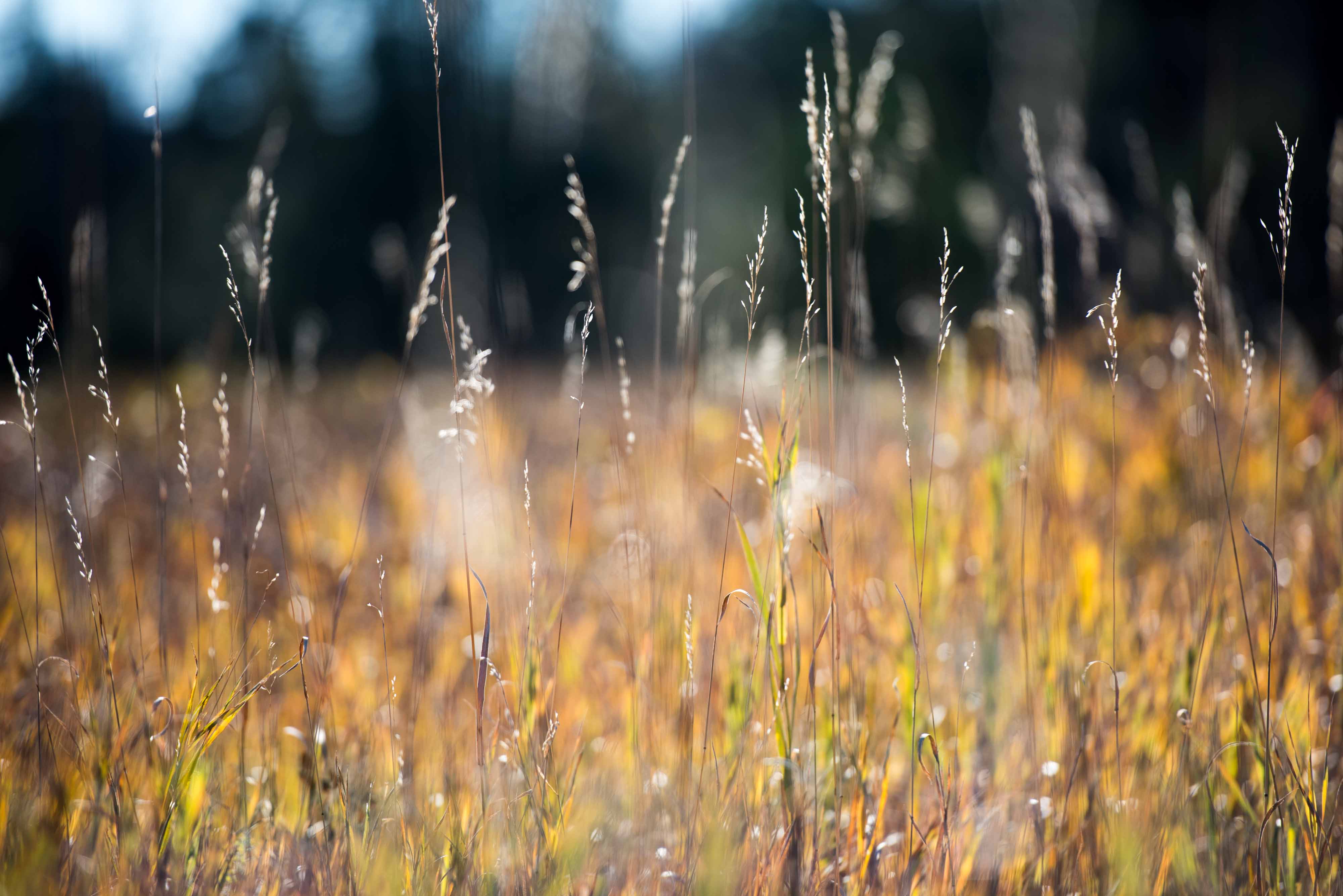
"Morning Sanctuary." One of my newest and most calming images. Coming soon to the new print shop (currently in development).
If you appreciate this level of landmark project documentation, or if you're drawn to what vast landscapes teach us about peace, resilience, perspective, and renewal, Boundless might be for you.
New issues arrive every Sunday through the library's opening day, July 4, 2026.
Boundless is the weekly newsletter of photographer Chad Ziemendorf. Each issue explores what vast landscapes and landmark human endeavors teach us about peace, resilience, perspective, and renewal.
I'm a contractor documenting this project, not an expert on construction. The opinions here are mine alone. And while I do my best to get the details right, I can't guarantee perfect accuracy on every technical point. If something's off, let me know.
All content and images © Chad Ziemendorf. All rights reserved.
Recent thoughts on craft, process, and the work where monumental human endeavors meet vast, quiet landscapes - including the latest from my Boundless newsletter.
Boundless 00014 // Work Worth Doing
Boundless 00013 // Faces of the TR Library
Forty-four portraits from three years of documenting the Theodore Roosevelt Presidential Library. No story arc. No commentary. Just the workers - and a photographer's thank you.
Boundless 00012 // There Will Be Signs
On my last trip to Medora, the rhythm had changed. The crews have crossed the line from building a landmark to finishing one. You can feel it the moment you walk in.
Boundless 00011 // From Seed To Roof
How 400,000 native plants traveled from hand-harvested seeds in the North Dakota Badlands, to a nursery in Wisconsin, to the roof of a Presidential Library. One plug at a time.
Boundless No. 00010 // Art Is Saying Stop
Boundless No. 00009 // Skin In The Game
37 photographs documenting the glass, wood, stone, steel, and ceiling finishes that make up the skin of the Theodore Roosevelt Presidential Library.
Share:
Boundless No. 00002 // But First, Dirt
Boundless No. 00004 // An Exhale For Your Soul