



This article was originally published as a Boundless newsletter. New issues arrive every Sunday.
Hi Friends,
Last week we brought the Badlands inside. A 30-foot, 240-foot-long curved wall made of compacted earth, layered in 44 individually colored lifts, built by a North Dakota concrete contractor who had never attempted anything like it before. The showstopper.
This week we step back and look at select surfaces. The glass. The wood. The stone. The framework. The ceiling overhead and the pavers underfoot. The bones hidden behind drywall that nobody will ever see.
Every finish of this building was intentional. The Living Building Challenge's banned chemical list eliminated hundreds of standard building materials, so the skin of the Theodore Roosevelt Presidential Library isn't decoration applied over a strategy. It is the strategy, made visible.
Let's dig in.

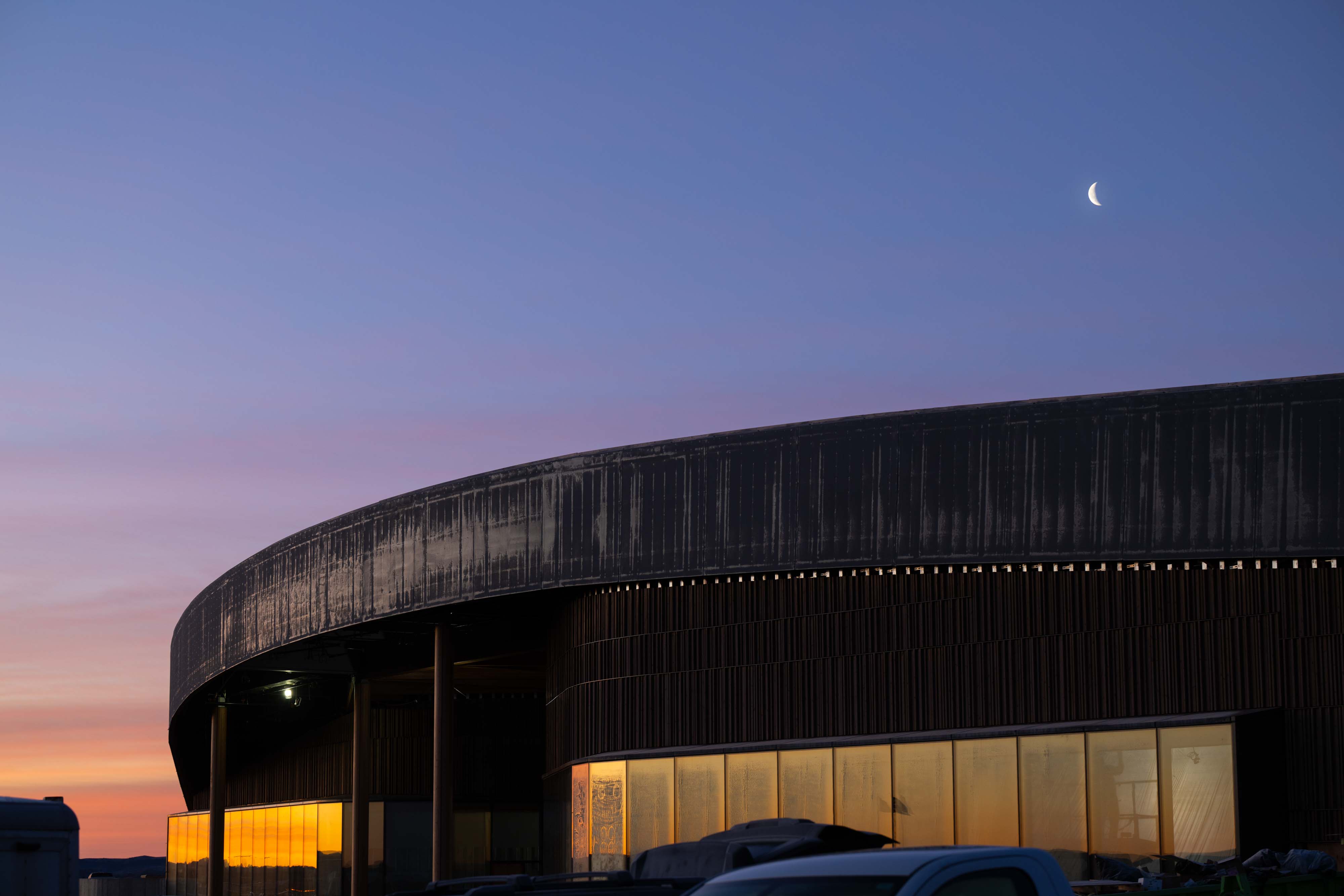
The Theodore Roosevelt Presidential Library before sunrise, the moon sitting above the roofline. February 2026. All images © Chad Ziemendorf.
The most transparent material in the building carries the most important job. The glass curtain wall and the timber curtain wall system don't just let light in - they keep the Badlands visible from inside at all hours. That connection was never accidental.

The timber curtain wall outside the auditorium before glass installation. The glulam mullions carry the same material philosophy as the mass timber ceiling above. July 2025.

Interior view looking out through the unglazed timber curtain wall framing. July 2025.
H Window manufactured the timber curtain wall system, a structural glazing system that uses engineered glulam mullions rather than aluminum. That distinction matters. The framing of the window is made of the same material as the beams above it. When you stand inside and look out at the Badlands, the material connecting you to that view is wood.

The first glass panels being set into the curtain wall framing. July 2025.

WL Hall Company setting glass panels in the breezeway curtain wall. September 2025.
Craig Dykers, Snøhetta's founding partner and the architect behind this building, described the intent simply: “We’re trying to slow people down, so they look down at their feet for a moment or look across the horizon for a moment, to get a different sense of time.”1
The glass is the mechanism for that. It puts 50 miles of Badlands within arm's reach of a visitor who just drove in from the interstate. That transition - from movement to stillness, from noise to horizon - is what the curtain wall is actually doing.

Library construction workers reflected on both sides of the glazed breezeway curtain wall. November 2025.

The north glass curtain wall just before sunset, the Badlands reflected back against itself. October 2025.
Before any siding panel was touched, SFS had to solve a structural problem. The wood rain screen - the wood cladding that wraps the outside of the building - cannot simply be nailed to the wall. It needs to float. The building breathes in North Dakota's climate, where temperatures range from minus 30 in the winter to over 100 degrees in the summer. The SFS bracket system holds the panels slightly off the wall face, creating a ventilated air gap that manages moisture and accommodates thermal movement year-round.

SFS custom brackets mounted to the exterior wall, awaiting the rain screen panels. June 2025.

The SFS bracket system wrapping the northwest corner of the building. The brackets hold the siding panels slightly off the wall face, creating a ventilated air gap that manages moisture year-round. June 2025.

Siding installation on the northwest corner, the Badlands sitting in the background. February 2026.
The panels themselves were fabricated off-site at JE Dunn’s PreBuild facility in Kansas City, built with sustainability and efficient installation in mind. JE Dunn project manager Trever Leingang described the flow: “The panel system greatly benefits the installation process - they will be constantly sending us material over the next nine months.”2 Tooz Construction handled the installation on site.

The very first delivery of rain screen panels arrives on site. Workers measure for verification before installation begins. July 2025.

Tooz Construction workers fine-tune a panel before it goes up. January 2026.

A rain screen panel swings into position. January 2026.

Tooz Construction worker's shadow falls across the finished siding. November 2025.

I borrowed a harness and hitched a ride in an adjacent man lift to capture Tooz Construction's perspective - the brackets ready, the next panel coming. February 2026.

The view visitors will first encounter walking from the parking lot toward the library - the SFS brackets and the completed rain screen working together. February 2026.
Boundless delivers a new photo essay every Sunday.
Each issue explores what vast landscapes and landmark human endeavors teach us about peace, resilience, perspective, and renewal.
Hardscapes Plus handled the stone at the base of the building and the base of its columns - the material at ground level that anchors everything visible above it. Their full scope on this project extends to the rooftop walkways, the stone staircase leading to the roof, and the benching around the shade canopy. (I'll cover the entire roof in more detail in a future issue).

Hardscapes Plus setting stone at the base of one of the library's exterior columns. November 2025.

A Hardscapes Plus worker finishing the stone at the base of the staircase leading up to the roof. January 2025.
Senator Kevin Cramer, who attended the final beam ceremony in 2024, described what the stone - and really every exterior material on this building - is doing: “So much of construction and development replaces nature with a structure. In this case, they’ve built a structure into nature - and that tells the story of Theodore Roosevelt so beautifully and with such integrity.”3
Most buildings treat the approach as an afterthought - concrete or asphalt between the parking lot and the front door.
Not this one.

The wood block pavers - approximately 5-inch cubes - set near the front entrance. October 2025.

CD Tile & Stone of Blaine, Minnesota, setting the wood block pavers. October 2025.

The paver installation seen from the roof. October 2025.
CD Tile & Stone of Blaine, Minnesota installed these - approximately 5-inch cubes of wood set into the parking area and the approach near the front entrance. They are warm underfoot. They are unexpected. They are a delightful surprise and variation in texture as visitors approach the main entrance, and the design team considered them with the same care as the 30-foot rammed earth wall waiting inside.

Workers installing the boardwalk planks near the main entrance. July 2025.

The boardwalk leading toward the main bridge on the western side of the library. February 2026.
The boardwalk is a story of its own - one I'll give a full issue to at some point. What you can see here is the scale of it, and the way it moves you from the building toward the landscape, the deck guiding you through the prairie until you are surrounded by sky and coulees.

Sands Wall Systems assembling metal wall framing in the interior. June 2025.

Interior metal framing taking shape. September 2025.

The painting crew at work. The black wood wool acoustic panels visible overhead are already in place. January 2026.

Newly installed reclaimed wood flooring, a worker clearing debris prior to sealing. February 2026.
Neither is glamorous. Neither photographs the way a 30-foot rammed earth wall photographs. But both had to pass the same scrutiny. The Living Building Challenge's banned chemical list disqualifies hundreds of standard drywall products for their formaldehyde content alone. The material nobody touches had to justify its chemical composition the same way the showstopper did.

The geometry required to frame the skylight opening just outside of the auditorium entrance. October 2025.

Sheets of 7-gauge weathering steel staged on the rooftop, waiting for installation. September 2025.

Standard Sheet Metal working on the skylight shrouds. October 2025.

Standard Sheet Metal workers reflected in the face of their own assembled skylight as they measure for the next piece of shroud. February 2026.
From the outside, the skylights look like sculptural forms breaking through the building's earth roof - deliberate protrusions that mimic the shape of the surrounding terrain. Standard Sheet Metal fabricated and installed them in 7-gauge weathering steel, roughly 3/16 of an inch thick. Substantial fabrication work.
The material is designed to oxidize to a specific patina and then stabilize. Not decay, but settle. The rust is the finish.
It mimics the same deep orange-red as the Badlands buttes in every direction. A material that came from the earth, was shaped by human hands, and will spend its next years returning to the color of the land around it.
From inside, these skylights are the source of the natural light that washes the rammed earth wall in color. The glass ceiling panels and skylight openings channel Badlands light into the building's most interior moments.

Looking straight up at the Linea grille ceiling installation in process - one panel installed, three waiting. This image was selected as a finalist in the 2025 ENR Photo Competition. November 2025.

A carpenter installing Linea grille panels in the main entry. February 2026.
This is the last surface between a visitor and the structural bones of the building, and it is also the surface you stand under longest.
Linea Ceiling & Wall Systems provided the wood grille panels. They fill the triangular spaces between the mass timber beams in the public areas of the building, wrapping the structural geometry in something warm and ordered.

Detail of the ready-to-be-installed Linea grille panels. February 2026.

A level belonging to the tile crew finishing the fireplace near the auditorium entry. February 2026.
In certain exhibit spaces, wood wool panels take over. The material looks like bundled pine straw - dense, fibrous, organic in the best way. It absorbs sound but is inconspicuous thanks to its custom black finish. ARUP Group, the acoustic engineering firm working alongside Snøhetta on the project, designed the ceiling system that brings structural timber, Linea grille, and wood wool together into a continuous acoustic and visual experience.

The installation plans for the ceiling grid. Fitting custom panels into the triangular geometries of a curved timber roof required precision at every junction. February 2026.
Standing in the main entry of this building, you are surrounded by the same basic material in seven different expressions: structural glulam beams overhead, exposed CLT panels in the breezeway, Linea grille filling the spaces between, wood wool panels in the exhibit rooms, steel columns wrapped in wood cladding, wood block pavers underfoot outside the entrance, rain screen panels visible through the glass on the exterior walls. Wood everywhere, doing different jobs, speaking the same language.

Joe of IBEW 714 and currently contracted with Parsons lowers his man lift after removing the last temporary work light from the breezeway, leaving the uninterrupted view of the mass timber and Badlands.
Theodore Roosevelt did not build a public persona and then go looking for the character to match it. He went to the Badlands broken, grieving and uncertain, and let the hardest conditions available to him build something real. The man who came back from North Dakota was not a performance of strength. He was the result of it.
This building works the same way. The values were established first - the Living Building Challenge, the sustainability targets, the banned chemical list, the insistence on materials that earn their place. Then the surfaces followed. Every finish of the Theodore Roosevelt Presidential Library is an honest account of what's underneath it. What visitors see when they walk in is not a surface-level presentation of those values. It's the identity made visible.
Next week, honestly, I'm not sure. I've been workshopping several different stories behind the scenes at the same time. While I can't give you a sneak peek like I normally do, I can guarantee that it will be worth your time and will leave you better than it found you.
See you next Sunday.
Chad Z.
If Boundless has been worth your Sunday morning, consider subscribing or passing it along to someone who’d appreciate it.
Boundless is the weekly newsletter of photographer Chad Ziemendorf who uses a camera to create visual anchors in an accelerating world. Each issue explores what vast landscapes and landmark human endeavors teach us about peace, resilience, perspective, and renewal. Currently documenting the Theodore Roosevelt Presidential Library through opening day, July 4, 2026.
I'm a contractor documenting the TR Library project, not an expert on construction. The opinions here are mine alone. And while I do my best to get the details right, I can't guarantee perfect accuracy on every technical point. If something's off, let me know.
All content and images © Chad Ziemendorf. All rights reserved.
Recent thoughts on craft, process, and the work where monumental human endeavors meet vast, quiet landscapes - including the latest from my Boundless newsletter.
Boundless 00014 // Work Worth Doing
Boundless 00013 // Faces of the TR Library
Forty-four portraits from three years of documenting the Theodore Roosevelt Presidential Library. No story arc. No commentary. Just the workers - and a photographer's thank you.
Boundless 00012 // There Will Be Signs
On my last trip to Medora, the rhythm had changed. The crews have crossed the line from building a landmark to finishing one. You can feel it the moment you walk in.
Boundless 00011 // From Seed To Roof
How 400,000 native plants traveled from hand-harvested seeds in the North Dakota Badlands, to a nursery in Wisconsin, to the roof of a Presidential Library. One plug at a time.
Boundless No. 00010 // Art Is Saying Stop
Boundless No. 00009 // Skin In The Game
37 photographs documenting the glass, wood, stone, steel, and ceiling finishes that make up the skin of the Theodore Roosevelt Presidential Library.
Share:
Boundless No. 00008 // The Showstopper
Boundless No. 00010 // Art Is Saying Stop