



This article was originally published as a Boundless newsletter. New issues arrive every Sunday.
Quick note: you may have noticed we skipped from issue 00006 to 00008. We did some internal housekeeping to keep things organized. Last week's issue about mass timber is now 00007.
Hi Friends,
If you missed last week, it's worth a look - we explored the mass timber and the 1,800 cubic meters of engineered wood that give the Theodore Roosevelt Presidential Library its warmth, its weight, and its connection to Roosevelt's conservation legacy. Then, I left you with a preview:
"The showstopper. The centerpiece design element of the Theodore Roosevelt Presidential Library."
This is the showstopper issue.

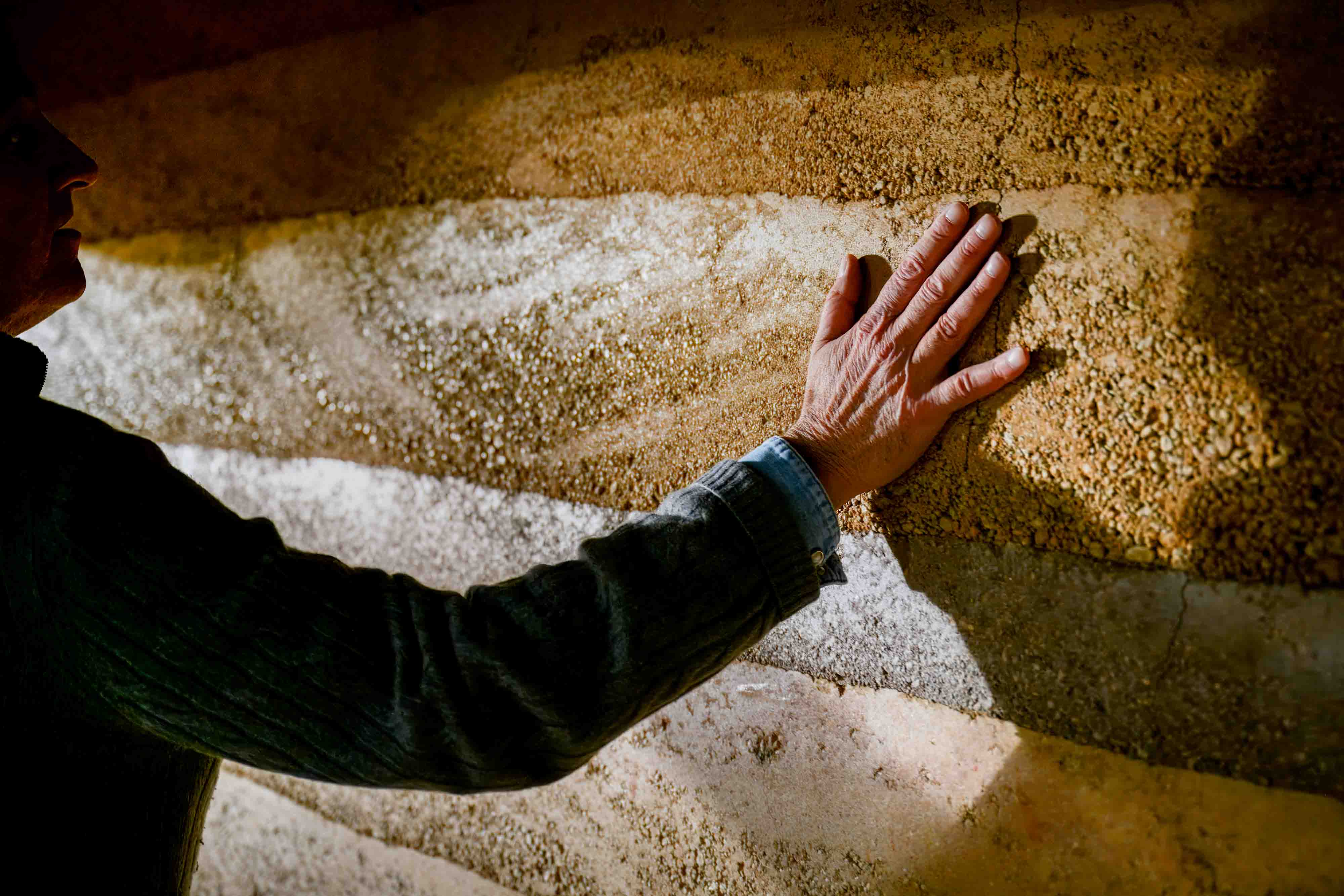
A worker gently brushes the face of the newly revealed rammed earth wall just after the formwork came down. September 2024. All images © Chad Ziemendorf.

All four rammed earth wall sections seen together for the first time after the formwork was removed. This image was featured in Fast Company in their coverage of rammed earth construction. September 2024.
Today we bring the Badlands inside the building. Described simply as "a showstopper" by the Fargo Forum, and "one of the most visually striking aspects" of the entire design by Snøhetta.
It is 30 feet high. It is 240 feet long. It curves.
Let's dig in.
Before it Looked Like Anything.
Before any of this existed, there was a fabric-roofed shelter sitting on bare ground about 50 yards from where the library was rising. Two shipping containers placed side by side with an arched white canopy stretched between them - the Winn Construction logo stenciled on the side. Under that canopy, tons of dry earth material were stored and staged, protected from the elements.

The temporary fabric-roofed shelter built to protect raw earth material from the elements - two shipping containers anchoring an arched fabric canopy. August 2024.

Workers begin assembling the curved plywood formwork that would shape the wall. The forms used specialty materials from UFP Concrete to hold the curve across 240 feet. June 2024.

Assembling the curved plywood formwork before installation. Getting the geometry right required precision at every joint. June 2024.

Another view of the formwork assembly process. These forms would eventually hold two million pounds of compacted earth material. June 2024.
Winn Construction is a concrete contractor out of Dickinson, North Dakota - a company Willie Winn founded in 1981. They had never built a rammed earth wall before. Nobody in North Dakota had built one like this in modern times. When Winn took the job, he and his team traveled to Cheyenne and Sheridan, Wyoming to study other rammed earth walls in person. They brought in a consultant to help develop the mixture recipe. They built a 10-foot-tall mock-up wall at their shop in Dickinson.
Then they did it.
Willie Winn calls the opportunity "a privilege."

The layer-by-layer color chart prepared by rammed earth consultant Brad Mimiltz of Earth Wall Builders, documenting each of the 44 lifts, corresponding mineral pigment colors, and installation notes. Late August 2024.
Every layer of this wall has its own color. The chart in the image above is the recipe. Each horizontal band visible in the finished wall corresponds to a specific pigment mixture, carefully measured and documented before a single bucket of material was moved. The striations you see when you stand in front of the completed wall were not accidental. They were engineered, layer by layer, to mirror the sedimentary formations visible in every Badlands butte outside.
The recipe called for 43 individually colored lifts, plus a cap layer at the top that matched the color of the lift below it. Forty-four layers in total.
Layer by Layer.
The formwork - the temporary molds that contain the wall as it's built - was engineered specifically for this project. Curved edges, smooth interior faces, designed to produce the wall's signature curve and clean surface. Building a straight rammed earth wall is one thing. Building a curved one, 240 feet long, at this scale, was something else entirely.

A skid steer positions a fresh bin of mineral pigment at the mixing hopper. Each layer required a precisely measured dose of tint to match the color sequence. Late August 2024.

A Winn Construction worker and rammed earth consultant Brad Mimiltz of Earth Wall Builders review the material and break up oversized clumps. Mimiltz guided the crew through every stage of the build. Late August 2024.
Here is how the process worked.
Skid steers carried batches of dry material from the staging shelter into the library and dumped them into an auger-style mixing hopper. At that hopper, the mineral pigment for that specific layer was added to the mix - each color assigned to its precise moment in the sequence. The hopper blended the material and pigment together, then fed it onto a telebelt: a truck-mounted conveyor system designed to place material in elevated or hard-to-reach locations.
The telebelt lifted the blended mix up and poured it into the waiting forms.

Tinted earth material travels up through the auger-style mixing hopper on its way to the telebelt - the truck-mounted conveyor that carried each blended batch up and into the formwork. Late August 2024.

The telebelt - a truck-mounted telescoping conveyor - delivers blended earth material into the formwork high above. Late August 2024.
Each loose layer was placed at roughly 12 inches - the consistency of good road base, as Winn supervisor Kenny Jessop described it. Then it was compacted. Pneumatic rammers worked across the entire surface of the form, compressing that 12-inch layer down to its final 8-inch thickness. Then another layer went on top, and the process started again.
For safety, the crew worked in four-foot sections of wall height at a time.

A worker uses a wood plank to guide incoming material into position within the formwork before compaction begins. Late August 2024.

High on the scaffolding, Winn workers compact a fresh layer using a hand tamper at left, a pneumatic rammer at center, and a narrow shovel to work material into tight corners. Each 12-inch loose layer compressed down to 8 inches. August 2024.

Measuring the depth of a compacted layer to confirm it met spec. Consistency across every lift was essential to both the structural integrity and the finished appearance. Late August 2024.
Not everything that came out of the mixer made it into the wall. The tumbling action of the mixing process sometimes caused small spherical nodules to form - cement and aggregate rolling into tight balls that would have created inconsistencies in the finished surface. Workers pulled them out and collected them in buckets. Quality control, one handful at a time.
Fifteen men. Just over three months. Twelve thousand man-hours. Two million pounds of material.

Cement balls - spherical nodules that form during the mixing process - collected before placement. Leaving them in the mix would have created voids and weak spots in the finished wall. Removing them was a standard quality control step on every layer. August 2024.

Fallen earth material near the base of the wall shows the range of mineral pigment colors used across all 44 layers - an unintentional record of the color sequence built into the wall above. Late August 2024.
Enjoying this? Boundless is a free weekly newsletter delivering behind-the-scenes documentation of the Theodore Roosevelt Presidential Library, plus reflections on what vast landscapes teach us about peace, resilience, perspective, and renewal.
Subscribe here → to get the next issue delivered to your inbox every Sunday.
When the Forms Came Off.
The moment the forms are removed from a rammed earth wall is unlike most reveals in construction. There is no curing time to wait for, no paint to dry, no finishing work ahead. What you see when the plywood comes off is what you have. Permanent.

Workers strip the curved plywood formwork from the first completed wall section. The moment the forms come down is when the work becomes real. Early August 2024.

As formwork panels are removed, construction dust falls from the debris left on top of the form. Early August 2024.

The first look at the first completed wall section - layers of orange, tan, and grey compressed into a 30-foot surface that reads like a cross-section of the Badlands themselves. Early August 2024.

Stripping the formwork from the central wall section. By this point, the crew had refined the process through the earlier sections. Late August 2024.

Another view of formwork removal from the central wall section, showing the scale of the operation and the layered surface emerging beneath. Late August 2024.
The staining on the pulled forms tells the story backward. Every layer that touched the plywood left its color. What reads as a construction byproduct is actually a record of the entire sequence in reverse - the wall's geology imprinted on the mold that shaped it.

Removed formwork panels stacked near the wall, stained with mineral pigments from each layer they held in place. The forms carry the color history of the wall in their grain. Late August 2024.
The Showstopper.
What reads as a single continuous wall is actually four separate walls working together, curving 240 feet across the main hall in a unified composition.
Snøhetta's Aaron Dorf described what drove the design decision: "We were looking to create a building that is of the place. The surrounding landscape is defined by layers and layers of earth that you see - it's profoundly beautiful."
The wall is the answer to that instinct made physical. It does not decorate the main hall. It grounds it. When you walk in, the Badlands have already arrived ahead of you.

A detail view of the central wall face, with removed formwork panels on the ground below. The texture of each compacted lift is clearly legible in the surface. Late August 2024.

The rammed earth wall revealed - 30 feet high, curving 240 feet across the main hall, with 44 layers of color drawn from the palette of the North Dakota Badlands.
Fast Company wrote that the living building is "intentionally tactile so that visitors feel a connection with nature that's pervasive" - that the design "draws as much inspiration from the uniqueness of the land as it does the uniqueness of the man."
That description fits the wall better than anything else in the building. The Badlands are sedimentary. They are layered. They are the product of time pressing down on earth. So is this.

A Winn Construction worker walks through what will become the main lobby, the newly revealed rammed earth wall rising behind him.

Ongoing construction near the main entrance, with two of the four rammed earth wall sections flanking the main corridor - a preview of what visitors experience upon entering. January 2026.
A Hand on the Wall.
In March of 2025, I was on site to photograph a VIP tour - benefactors, supporters, and members of the Roosevelt family walking through the library on a spring morning. Toward the end of the tour, Simon Roosevelt paused in front of the wall and ran his hand across it.
I was there to photograph it.
I have thought about this image many times since. The wall is made from earth - the same kind of layered, ancient earth that shaped this landscape, and the landscape that shaped Theodore Roosevelt during the years he spent here after losing his wife and his mother on the same day. A descendant of the man whose name is on the building, walking alongside a wall that carries the Badlands inside it, touching the thing that can't quite be explained.
That's what a showstopper does. It captivates you, and you reach out.

Simon Roosevelt, great-great-grandson of President Theodore Roosevelt, takes a quiet moment with the rammed earth wall during a VIP tour in March 2025.
Next Week.
Next week, we step outside and look at how the Theodore Roosevelt Presidential Library meets the world - the wood rain screen, the weathering steel skylight shrouds, the glass curtain wall, and the stone at the building's base. Everything that makes up the skin of this building.

The forms come off. The rammed earth wall reveals itself. August 2024.
See you next Sunday.
Chad Z.
Want More Like This?
If you appreciate this level of landmark project documentation, or if you're drawn to what vast landscapes teach us about peace, resilience, perspective, and renewal, Boundless might be for you.
New issues arrive every Sunday through the library's opening day, July 4, 2026.
References
- Fargo Forum, June 25, 2025 — "A 'showstopper' wall rises in Medora, putting the Badlands' true colors on display"
- Fast Company, 2024 — "Why the Theodore Roosevelt Presidential Library is unlike anything you've seen"
- Fast Company, 2025 — "How Architects Are Using an Ancient Building Technique to Combat Climate Change"
- Snøhetta Construction Update
Boundless is the weekly newsletter of photographer Chad Ziemendorf. Each issue explores what vast landscapes and landmark human endeavors teach us about peace, resilience, perspective, and renewal.
All content and images © Chad Ziemendorf. All rights reserved.
Share:
Boundless No. 00007 // Beauty & Brains
Boundless No. 00009 // Skin In The Game