



Welcome to the first issue of Boundless. This was first emailed to subscribers on Sunday January 18, 2026.
Housekeeping: Some of you might still be receiving the Welcome Series if you signed up recently. This is the first issue of the weekly rhythm — you may still get a few more welcome emails that share insight about what I do, my process, and why I do it.
Did somebody forward you this email? Sign up here so you can get your very own in your inbox every Sunday.
Hi Friends,
It feels good to finally be out of the gate. Today's first issue takes you into the decision that shaped this entire TR Library project - and why the architects chose to protect something you feel before you have words for it. Hint: it's the same thing that drives my own work. Let's get into it.

Painted Canyon, near Medora, North Dakota. All images © Chad Ziemendorf.
This is what Snøhetta saw when they first arrived in Medora.
Not a building site. Not a construction challenge. A landscape that does something to you before you have words for it.
There's a physical response that happens in places like this - shoulders dropping, breathing slowing, the mental noise quieting without effort.
I've come to think of it as the exhale.
It's what vast, uninterrupted space offers when you stop long enough to receive it.
The architects felt it. And they made a decision that would shape everything that followed: they refused to interrupt it.

Aerial view of the Theodore Roosevelt Presidential Library and surrounding property, November 2025.
The original instinct was obvious. Position the library at the southern edge of the property, overlooking the dramatic canyon views. Visitors would arrive and immediately confront the Badlands sprawling below them. The architecture would command the view.
Snøhetta walked to that edge, felt the pull of that drama, and chose differently.
They moved the entire project to the north end. The rolling prairie became the library's front yard. The building became something you discover gradually - after you've already started breathing differently.
Craig Dykers, Snøhetta's founding partner, explained it plainly: "This is beautiful. Why would we want to ruin all of this? No matter how great the building is - I don't care if it's the most beautiful building in the world - you cannot replace the landscape that you're taking away from people's ideas."
That's not architectural philosophy. That's restraint as design principle. Knowing when the best thing you can offer is to step asid The library as seen from Theodore Roosevelt National Park, in July 2025. If it weren't for the temporary lime green glass-mat sheathing, it would virtually disappear into the rolling hills.
From certain vantage points in Theodore Roosevelt National Park, the library nearly disappears. The roofline follows the roll of the hills. The materials echo the earth tones of the Badlands. You have to look for it.
Michelle Delk, Snøhetta Partner and leader of Landscape Architecture, described what they were designing for: "The main building settles quietly into the grasslands of the butte, coming in and out of view as visitors make their way from the town of Medora. As one approaches, the main building will welcome visitors like a polite host, rather than a performance unto itself."
A polite host. That phrase has stayed with me for years.
There's something in it that applies far beyond architecture - to how we show up in conversations, how we lead, how we create. The constant question: Am I making space for something to emerge, or am I performing unto myself?
Most of the world is designed to grab attention. This building is designed to give it back.
 The library settles into the prairie in this view from the southwest corner looking northeast.
Delk offered another line that I keep returning to: "Being bold doesn't have to be loud. In many ways, we really just wanted to invite visitors to slow down and to start to notice this incredible place."
Slow down. Notice. That's the exhale they're protecting.
We don't have many places left that ask this of us. Most environments, physical and digital, are engineered to accelerate us, to compete for our attention, or to extract something from us before we move on.
This place asks nothing. It offers space. What you do with that space is yours.
 The library's living roof meets grade at the southern edge — prairie flowing over architecture.
Dykers reframed what a presidential library could be: "Theodore Roosevelt was an incredible reader of books - he read thousands in his lifetime, more than anyone could possibly imagine. So we decided that the landscape can be a library. A Presidential Library could be the actual landscape that you would first learn about his life and his beliefs from."
This changes the experience entirely.
You don't arrive at a building that explains Roosevelt's connection to the land. You arrive at the land. You feel the wind that shaped him. You see the horizon that recalibrated his ambitions. You stand where he stood, long before you read a single exhibit panel.
The building supports that experience. It doesn't replace it.
 The Badlands and ND horizon reflected in the library's north glass curtain wall. Structure and landscape, blending.
I've photographed this project since early construction. Returned more times than I can count. Watched steel rise and timber settle and native grasses take root on the roof.
And the thing that still hits my soul isn't the architecture.
It's the horizon. The way light moves across the buttes in the hour before sunset. The silence that isn't silence - wind through grass, meadowlarks, the stillness of the land settling into evening.
The architects built a $450 million structure designed to point you back toward that. To get out of the way so the landscape can do what it's always done.
That's the exhale. And it's still available every time I return.
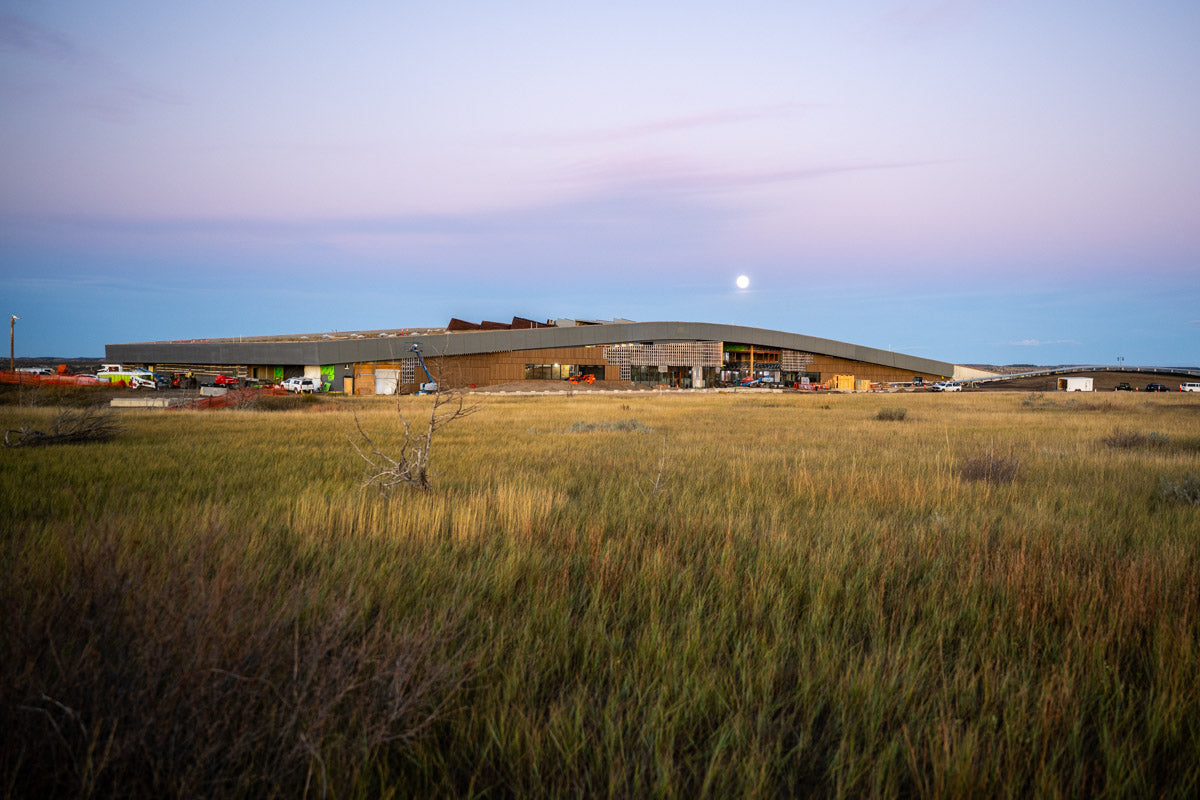
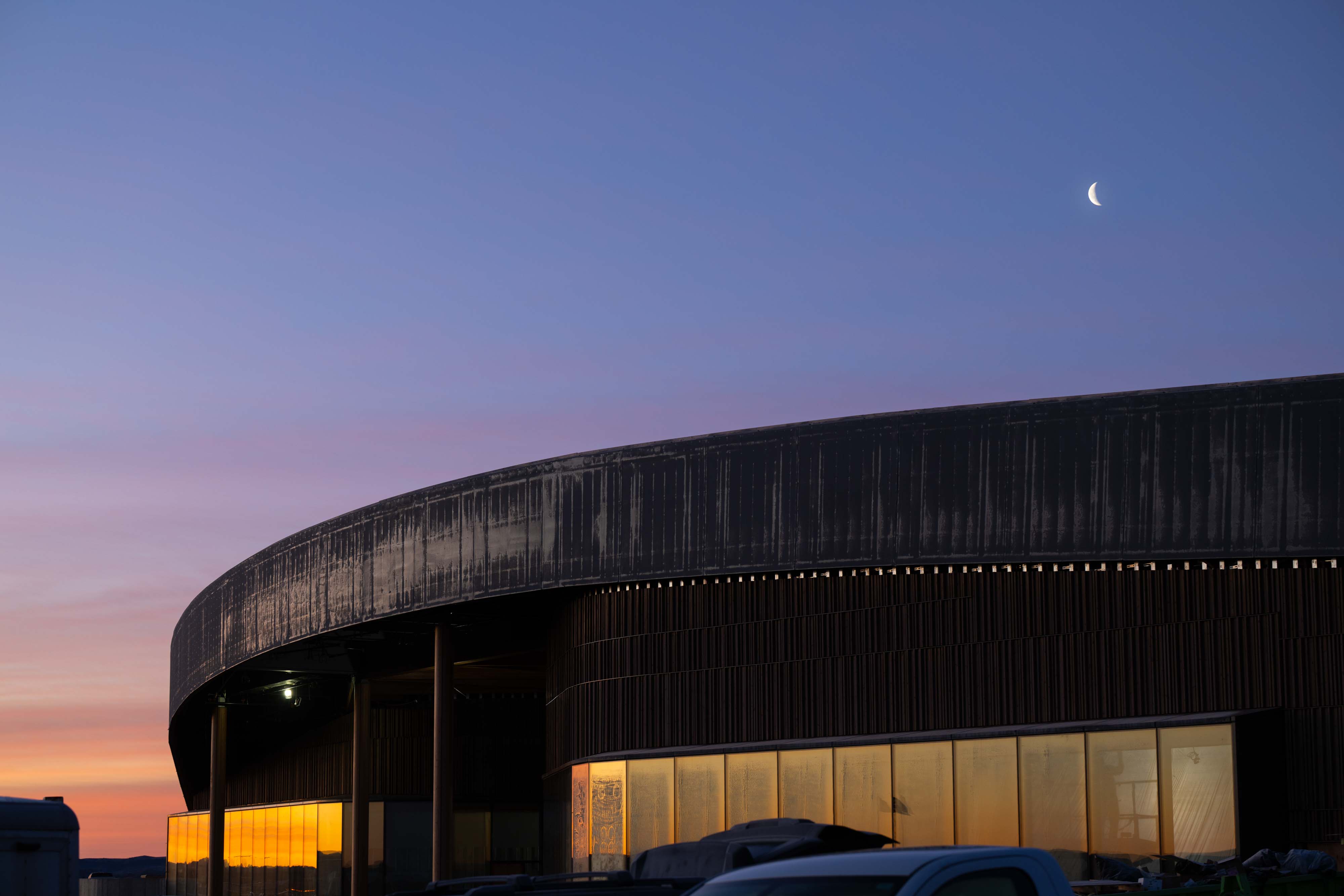
 Full moon rising over the Theodore Roosevelt Presidential Library, October 2025.
There's a reason this matters beyond aesthetics.
We're all carrying more than we realize. The pace, the noise, the constant pull of attention in twelve directions. Most of us have forgotten what it feels like to stand somewhere that asks nothing of us.
This place offers the gift of presence. The architects made sure of it.
 Glass installers from W.L. Hall Co. work beneath the library's curved roofline. The anatomy of a landmark — one trade at a time.
Here's what I have in mind for the weeks ahead:
The Dirt — how the team preserved 90,000 cubic yards of native topsoil
The Concrete — foundations anchoring the structure to bedrock
The Steel — framework rising against the Dakota sky
The Timber — mass timber that gives the interior its warmth
The Wall — a 30-foot rammed earth structure mirroring the Badlands' own layers
The Living Roof — 130,000 native plants returning home
The People — the hundreds of craftspeople, 75% North Dakota locals, building something meant to outlast us all
I'm still making regular trips to capture the final months of construction, so I might amend the plan as things unfold. But my goal stays the same: to reflect the character of the ND Badlands so that you can feel the same peace, resilience, perspective and renewal that I have (and leave you better than I found you).
Welcome to Boundless.
Chad Z.
P.S. — One of my TR Library images is a finalist for the cover of ENR Magazine, the construction industry's publication of record. To those who already voted: thank you. To those who haven't: voting closes Wednesday and you can vote once per device - computer, phone, and tablet all count. I'd love to see this project and its people on the cover in the year it opens.
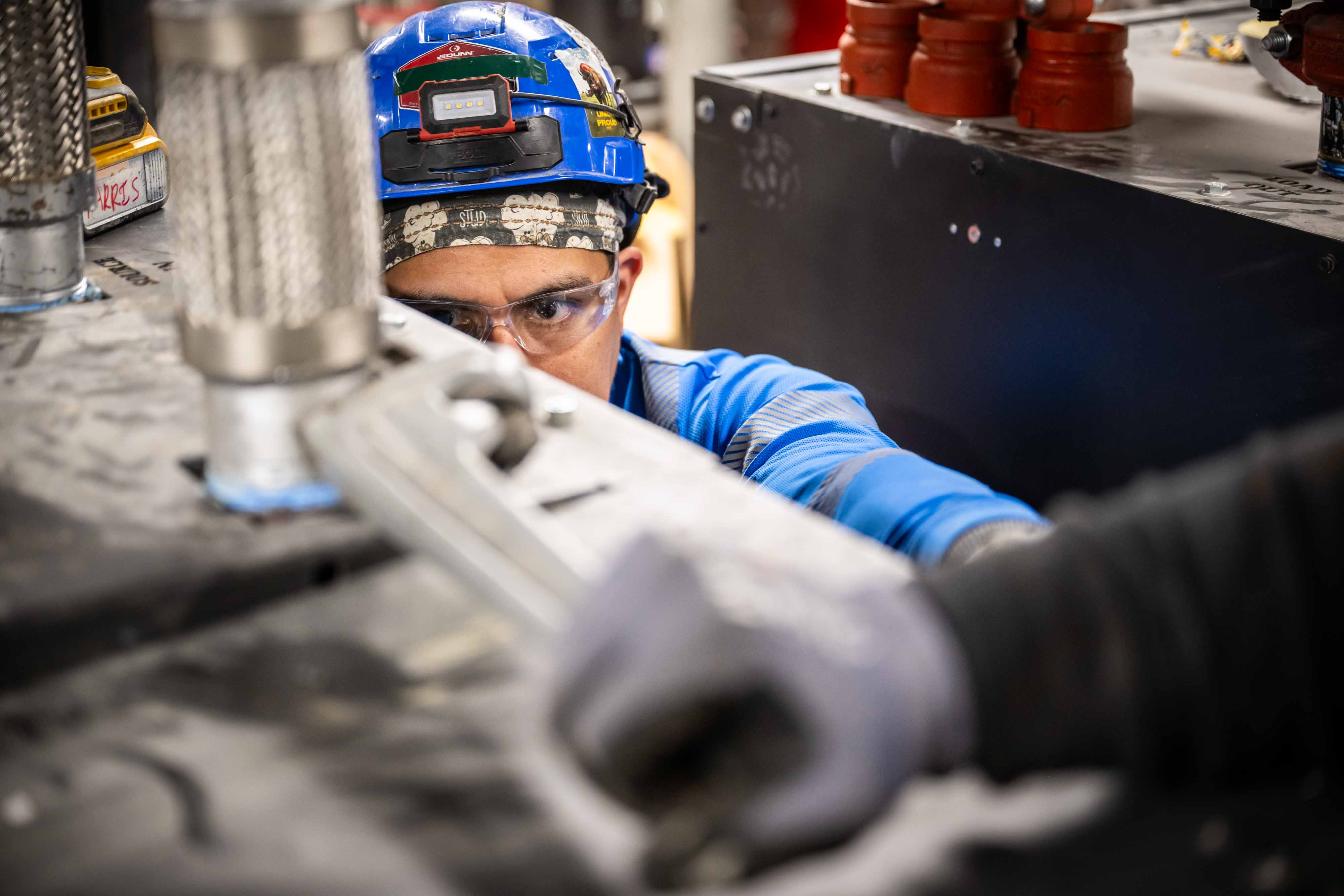
 A craftsman shapes HVAC ductwork inside the TR Library — one of hundreds of workers, 75% of them North Dakota locals, building something meant to outlast us all. This is the image I hope makes the cover — a top-10 finalist, chosen by judges and editors from more than 1,100 submissions. Vote here.
Boundless is the weekly newsletter of photographer Chad Ziemendorf who uses a camera to create visual anchors in an accelerating world. Each issue explores what vast landscapes and landmark human endeavors teach us about peace, resilience, perspective, and renewal. Currently documenting the Theodore Roosevelt Presidential Library through opening day, July 4, 2026.
All content and images © Chad Ziemendorf. All rights reserved.
Recent thoughts on craft, process, and the work where monumental human endeavors meet vast, quiet landscapes - including the latest from my Boundless newsletter.
Boundless 00014 // Work Worth Doing
Boundless 00013 // Faces of the TR Library
Forty-four portraits from three years of documenting the Theodore Roosevelt Presidential Library. No story arc. No commentary. Just the workers - and a photographer's thank you.
Boundless 00012 // There Will Be Signs
On my last trip to Medora, the rhythm had changed. The crews have crossed the line from building a landmark to finishing one. You can feel it the moment you walk in.
Boundless 00011 // From Seed To Roof
How 400,000 native plants traveled from hand-harvested seeds in the North Dakota Badlands, to a nursery in Wisconsin, to the roof of a Presidential Library. One plug at a time.
Boundless No. 00010 // Art Is Saying Stop
Boundless No. 00009 // Skin In The Game
37 photographs documenting the glass, wood, stone, steel, and ceiling finishes that make up the skin of the Theodore Roosevelt Presidential Library.
Share:
Help TR Library Make It On The Cover of ENR Magazine
Boundless No. 00002 // But First, Dirt