



Today's issue is about something most people dismiss before they've even thought about it. And how the team building the TR Library refused to make that mistake.
Let's dig in.

Bentonite clay and scoria fragments off of Magpie Road, only miles away from Theodore Roosevelt's Elkhorn ranch site. The gray clay swells to eight times its volume when wet. The red rock formed when underground coal seams baked the earth into natural brick. May 2014. All images © Chad Ziemendorf.
Soil is home to 59% of all species on Earth.1 That makes it the single most biodiverse habitat on the planet. More than rainforests. More than oceans. In other words, more life exists below ground than above it.
A single teaspoon of healthy soil contains up to a billion bacteria.2 A single gram holds roughly 4,000 different species.3
We walk on it every day. We scrape it off our boots. We call it "dirt."

The North Dakota Badlands as seen from Wannagan Creek Road near Medora, ND. June 2025.
The soil of western North Dakota is unlike anywhere else on Earth.
Bentonite clay derived from ancient volcanic ash can absorb several times its weight in water, swelling to eight times its original volume.4 That's why the ground becomes treacherously slick after a rainstorm. It's also why this clay is now used in everything from drilling fluids to pharmaceuticals to environmental sealing.
Beneath the surface, lignite coal seams have burned for decades. Sometimes centuries.5 The heat bakes the overlying sediments into natural brick, creating the vivid red caprock that defines the Badlands horizon.
Theodore Roosevelt, trying to capture this strangeness, put it simply: the Badlands look like Edgar Allan Poe sounds.6

The view a few steps from where Theodore Roosevelt's front porch would have been at his Elkhorn Ranch. June 2025.

Mixed-grass prairie. What remains of this biome stores carbon in root systems that reach deep into the earth.
Above that strange geology, something equally remarkable grows.
The American Prairie is the most endangered biome on the continent.7 More threatened than rainforests. More diminished than wetlands. What remains stores carbon in root systems that reach deep into the earth, locking it away for centuries.8
Mixed-grass prairie once covered this entire region. Now it exists in fragments. The soil beneath it holds more carbon than the atmosphere and all vegetation on Earth combined.9
That's the living system the TR Library sits within. And that's what made the earthwork so delicate.

Martin Construction begins earthwork on the library site, June 2023.
That's the ground Martin Construction and the JE Dunn team began working in 2023.
Their first task wasn't excavation. It was preservation.
Before a single foundation was poured, the team faced a fundamental question: how do you build on land this significant without destroying what makes it significant?

A scraper reflected in standing water after a spring rain. June 2023.

The blade peeling back the living skin of the prairie. June 2023.

Topsoil carefully separated from subsoil, stockpiled for later. June 2023.

Windrows of native topsoil stored at the edge of the site.
Over 90,000 yards of earth would eventually be moved.10 But the native topsoil received special treatment.
This wasn't ordinary fill material. It was the living skin of the prairie, rich with organic material and microorganisms accumulated over generations. The team carefully scraped it from the surface and stockpiled it nearby. Stored for months like a surgical team banking healthy tissue.
The plan: return it to the building itself.

The library taking shape within the landscape it was designed to honor. August 2024.
The Theodore Roosevelt Presidential Library is pursuing the Living Building Challenge, the world's most rigorous sustainability certification. Fewer than 40 buildings on Earth have achieved it.11
The LBC's "Place" petal requires deep respect for a site's ecology. By preserving and reintegrating that native topsoil, the team ensured the building wouldn't just sit on the Badlands. It would grow from them.
Jenn Carroll, the Foundation's Manager of Sustainability, put it simply: "With T.R.'s history being the conservation president, we felt like continuing that legacy was extremely important for our mission."12
Enjoying this? Boundless is a free weekly newsletter delivering behind-the-scenes documentation of the Theodore Roosevelt Presidential Library, plus reflections on what vast landscapes teach us about peace, resilience, perspective, and renewal.
Subscribe here → to get the next issue delivered to your inbox every Sunday.

The preserved topsoil began its return to the building in Winter 2024/2025.

Crews spreading topsoil on the living roof. January 2025.

Sunrise on the roof. January 2025.

A choreography of equipment moving earth into place. May 2025.

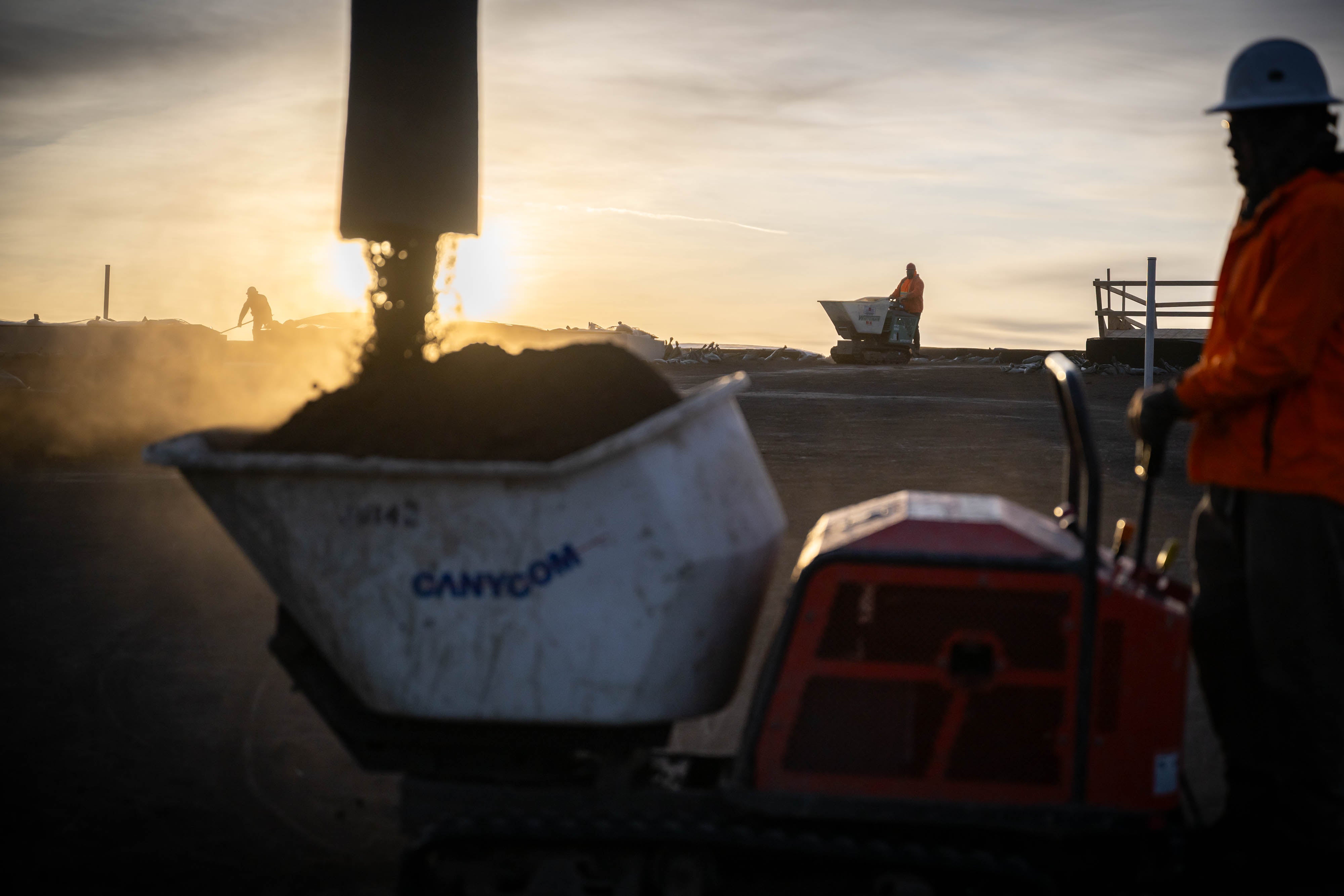
Conveyor depositing topsoil as workers survey the grade. May 2025.
Steve Fore, JE Dunn's General Superintendent, has spent his career on construction sites. He's seen how projects typically treat the ground beneath them.
This one was different.
"We're not just preserving history here," Fore said. "We're building history for someone else to preserve."13
That mindset shaped everything. The care. The intentionality. The willingness to spend months protecting something most projects would have scraped off and discarded without a second thought.

The living roof, June 2025. Topsoil spread, rooftop path framework installed, ready for planting.
The visible work gets the attention. Steel rising against the sky. Mass timber spanning impossible distances. Glass catching the Dakota light.
But the ground came first.
Not just in buildings. In anything worth building. The culture of a company. The character of a family. The trajectory of a life. The invisible work, the unglamorous decisions, the things no one applauds. That's where durability comes from.
Most projects rush to build the visible thing. This team spent months protecting what most would have overlooked.
That's how you build something meant to outlast you.

Hand-placing the first of 130,000 native plant plugs. The dirt work pays off. June 2025.
That stockpiled topsoil? It now blankets the library's living roof.
And from it, life is returning. Native grasses and plants that haven't grown on this exact site in over a century. 130,000 plant plugs, hand-placed in patterns that mimic the natural prairie.14
I'll dedicate a full issue to the Native Plants Project down the road. The seed collection. The cultivation. The army of hands that planted them. But for now, this image is proof of concept.
The dirt work mattered. What you're looking at is the result.

First concrete, August 2023. Next week: how Winn Construction anchored this vision to the earth.
The concrete that anchored this vision to the earth. Every footing. Every retaining wall. Approximately 3,500 yards poured before the first beam arrived.
See you next Sunday.
Chad Z.
If you appreciate this level of landmark project documentation, or if you're drawn to what vast landscapes teach us about peace, resilience, perspective, and renewal, Boundless might be for you.
New issues arrive every Sunday through the library's opening day, July 4, 2026.
Boundless is the weekly newsletter of photographer Chad Ziemendorf. Each issue explores what vast landscapes and landmark human endeavors teach us about peace, resilience, perspective, and renewal.
All content and images © Chad Ziemendorf. All rights reserved.
Recent thoughts on craft, process, and the work where monumental human endeavors meet vast, quiet landscapes - including the latest from my Boundless newsletter.
Boundless 00014 // Work Worth Doing
Boundless 00013 // Faces of the TR Library
Forty-four portraits from three years of documenting the Theodore Roosevelt Presidential Library. No story arc. No commentary. Just the workers - and a photographer's thank you.
Boundless 00012 // There Will Be Signs
On my last trip to Medora, the rhythm had changed. The crews have crossed the line from building a landmark to finishing one. You can feel it the moment you walk in.
Boundless 00011 // From Seed To Roof
How 400,000 native plants traveled from hand-harvested seeds in the North Dakota Badlands, to a nursery in Wisconsin, to the roof of a Presidential Library. One plug at a time.
Boundless No. 00010 // Art Is Saying Stop
Boundless No. 00009 // Skin In The Game
37 photographs documenting the glass, wood, stone, steel, and ceiling finishes that make up the skin of the Theodore Roosevelt Presidential Library.
Share:
Boundless No. 00001 // The Exhale
Boundless No. 00003 // Anchored To The Earth