



This article was originally published as a Boundless newsletter. New issues arrive every Sunday.
Hi Friends,
Last week I took a detour to wish my mom a happy birthday and share a story about the best photography advice I ever received. Thank you for all the kind responses to both.
In issue no. 00005, we followed the steel from TrueNorth Steel's facility in Mandan to the bluff in Medora where Innovative Builders spent seven months assembling the skeleton of the Theodore Roosevelt Presidential Library. This week, the mass timber.
Over the past several issues, every material in this building has required something from the environment. Dirt was moved. Concrete emits carbon during production. Steel demands mining and smelting. What arrived next changed that equation entirely.
Let's dig in.

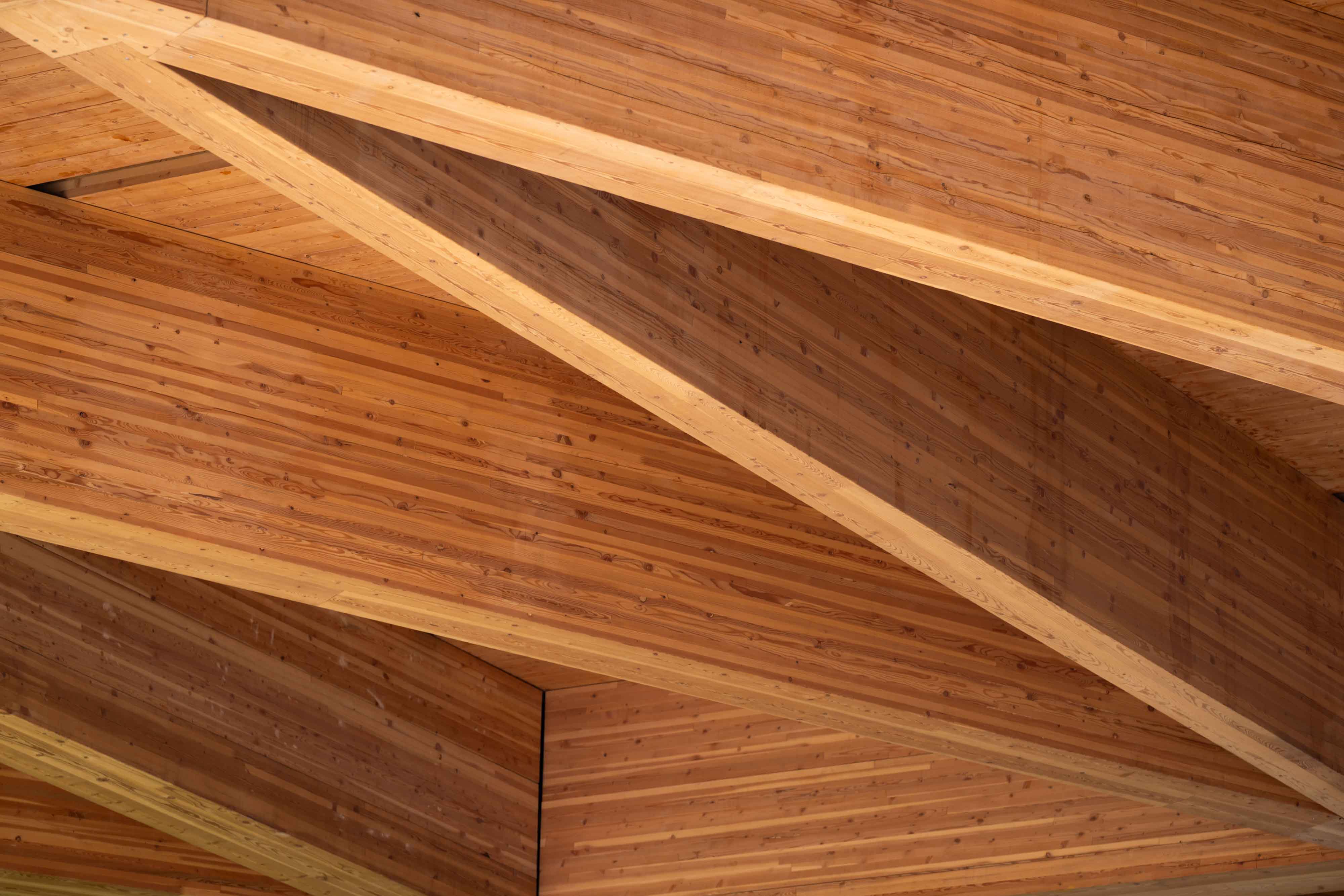
A detail of the finished mass timber ceiling. October 2025. All images © Chad Ziemendorf.

Mass timber and steel working together, looking across the breezeway toward the west building. August 2024.
In April 2024, Mercer Mass Timber began delivering nearly 1,800 cubic meters of engineered wood to a construction site in the North Dakota Badlands, making this the largest use of mass timber in the state's history.1
For readers who haven't encountered mass timber before: this isn't traditional lumber. These are manufactured structural products created by layering and pressing wood into panels and beams that can span long distances and carry loads typically reserved for steel and concrete.
Two types are at work here. Glulam beams are the long spanning members, arranged in a triangular pattern that follows the curvature of the roof. CLT panels (cross-laminated timber) are the flat engineered panels, roughly five feet by ten feet each, that form the roof deck and ceiling. Together, they give this building both its structure and its interior character.

Glulam beams staged on site, waiting for their turn. May 2024.

Deliveries continued through the fall. September 2024.

A glulam beam rises toward the roof as spotters watch from below.
Seagate's crew handled the installation, threading timber through the steel framework that Innovative Builders had spent the previous seven months assembling. Every glulam beam had to connect to the steel at specific connection points. The roof was designed to echo the rolling topography of the Badlands, which meant precisely engineered joints where no two connections were identical.
One detail worth noting: at the connection points, the steel was wrapped in wood to maintain a seamless timber look from below.2 That tells you something about the level of intentionality on this project. They didn't bolt wood to steel and call it done. They considered what a visitor standing underneath would eventually see and made the effort to unify the experience.
Ricardo Brites, Mercer Mass Timber's Director of Engineering, described the scope: "From custom made glulam connections to a curved roof profile that's as complex as it is beautiful, this project sets a new bar for civic architecture."2

Seagate's crew guides a glulam beam into position. September 2024.

Literally threading the needle. Three workers guide a glulam beam into its precision opening in the steel. May 2024.

The angle on the edge of each beam is cut to match its steel connection exactly. September 2024.

Every connection point is unique. Every angle is specific. September 2024.

A glulam beam descends toward its final position. August 2024.

September 2024.

A snug fit. A sledgehammer finishes what the crane started. September 2024.

Framed by steel, walking on timber. One of Seagate's crew above what will eventually be the library's cafe. August 2024.

Seagate's Ralph Austin walks the rooftop CLT panels, tracking progress with the Badlands behind him.

Anchoring CLT panels to the framework below with 25-inch screws. August 2024.

Twenty-five inches of fastener. August 2024.

One of many right-angle drills on the roof. The right tool for a 25-inch screw.

Mass timber spreading across the structure. The steel framework is visible beneath. September 2024.

Three phases of the roof in one frame: CLT panels on the left, rebar in the middle, concrete on the right. All of it sitting on mass timber. August 2024.
Here's the structural reality of what the timber is actually doing.
The CLT panels span the building's 93,000-square-foot footprint and carry the full weight of everything above them: waterproofing membranes, rebar, concrete topping, more waterproofing, insulation, walkways, benches, soil, and eventually 140,000 native plant plugs.3 That is an enormous distributed load, carried entirely by the timber and transferred through the glulam beams to the steel columns below.
Steel and timber are doing different types of structural work on this building, and neither could do it without the other. The steel columns handle the concentrated loads, the vertical transfer to foundations, the lateral stability that keeps the building standing in North Dakota wind. The timber handles the heaviest distributed loads across the greatest surface area. They're interdependent. Remove either one and the system fails.

The exposed mass timber beams in the breezeway near the main entrance. August 2025.

Late afternoon light in what will become the rotating gallery. January 2025.

The breezeway before the cladding was placed on the steel beams. August 2024.
Where the timber is exposed, it transforms the interior.
The first time I walked under the exposed mass timber, I could see a clear shift. The building stopped feeling like a construction site and started feeling like a place.
It's undeniable: wood adds a character of beauty and warmth. It does something to the way a place resonates in your body. Standing under exposed timber feels fundamentally different from standing under steel or concrete, and the architects knew that.
JE Dunn's Project Manager Trever Leingang put it this way: "Mass timber allows the building to feel warm, natural, and connected to the surrounding landscape. It's an embodiment of Roosevelt's belief in preserving and wisely using natural resources."4

Acoustic panels and ceiling grid conceal the mass timber above one of the exhibition rooms. January 2026.

Three scissor lifts, three carpenters, all installing acoustic panels that will hide the timber overhead. February 2026.
In some of the exhibition areas, the timber disappears.
Layers of mechanical systems, electrical conduit, fire suppression, wiring, speakers, projectors and decorative wood grids conceal the CLT panels overhead. If you didn't know the timber was there, you'd never see it. Construction workers on site have asked the obvious question: why cover up all this beautiful wood?
The answer reveals something about why this material was chosen in the first place.
Mass timber wasn't selected solely for how it looks. It was selected for what it does. Structurally, it carries the full weight of the living roof across the entire building. Environmentally, it sequesters carbon that would otherwise be in the atmosphere. Philosophically, it aligns the building's construction with the conservation values of the president it honors. The beauty where it's exposed is real and intentional. But the timber behind the finished ceilings is doing equally important work, carrying the same loads and storing the same carbon, whether anyone sees it or not.
Enjoying this? Boundless is a free weekly newsletter delivering behind-the-scenes documentation of the Theodore Roosevelt Presidential Library, plus reflections on what vast landscapes teach us about peace, resilience, perspective, and renewal.
Subscribe here → to get the next issue delivered to your inbox every Sunday.
This is where mass timber breaks from everything that came before it in the construction sequence.
Concrete's primary ingredient, cement, accounts for roughly 8% of global CO₂ emissions.5 Steel production emits approximately two tons of CO₂ for every ton of steel produced.6 These are essential materials, and the team used low-carbon alternatives wherever possible, but the emissions are inherent to the process.
Mass timber reverses the equation.
Trees absorb carbon dioxide as they grow, locking it into the wood. That carbon stays stored for the lifetime of the structure. According to Mercer Mass Timber's project reporting, the 1,800 cubic meters of CLT and glulam at the Theodore Roosevelt Presidential Library provide a total carbon benefit of 3,031 metric tons of CO₂. That's equivalent to the energy used to operate 320 homes for a year.2
This directly serves the building's pursuit of the Living Building Challenge, the world's most rigorous sustainability certification.3 The LBC's Materials Petal requires a 20% reduction in embodied carbon compared to a conventional baseline. Mass timber doesn't just reduce the number. It inverts it. And Mercer holds certifications from the Forest Stewardship Council, PEFC, and the Sustainable Forestry Initiative, ensuring the wood itself was responsibly sourced from sustainably managed forests.7
Theodore Roosevelt protected approximately 230 million acres of public land during his presidency. His library carries those values in its structure - in the sustainably sourced timber holding up the roof. This building doesn't just tell you what Roosevelt believed. It practices it.

Standing on timber, looking at the Badlands. A Seagate worker above the future cafe. August 2024.

Seagate's crew at work. September 2024.

Installing finishing caps where timber meets steel for a seamless wood appearance. March 2025.

September 2024.
There's a common assumption that you have to choose. The beautiful option or the smart one. The ambitious path or the responsible one. Aesthetics or performance. The mass timber at this library refuses that tradeoff.
Where it's exposed, it's one of the most visually striking interiors I've ever photographed. Where it's hidden, it's carrying 93,000 square feet of living roof. And regardless of whether you can see it, that timber is holding 3,031 metric tons of carbon that would otherwise be in the atmosphere.
One material. Structural load, carbon sequestration, natural warmth, and the conservation philosophy of the 26th president, all at once. No compromise on any of them.
The best decisions don't force a choice between what looks right and what is right. When those two things line up, it's because someone refused to settle for one or the other.

Skylights and mass timber in the main lobby. November 2025.

Ceiling, skylights, rammed earth, and glass curtain wall. Everything coming together in the main lobby. November 2025.
"The showstopper … the centerpiece design element of the Theodore Roosevelt Presidential Library."
Next week, we focus on the element that brings the Badlands inside the building - the rammed earth wall.

The forms come off. The rammed earth wall reveals itself. August 2024.
Winn Construction, a regional concrete contractor, agreed to build something they'd never attempted before: a curved rammed earth wall, 240 feet long and 30 feet tall, using an ancient technique that dates back thousands of years. The result looks like the Badlands themselves.
See you next Sunday.
Chad Z.
If you appreciate this level of landmark project documentation, or if you're drawn to what vast landscapes teach us about peace, resilience, perspective, and renewal, Boundless might be for you.
New issues arrive every Sunday through the library's opening day, July 4, 2026.
Boundless is the weekly newsletter of photographer Chad Ziemendorf. Each issue explores what vast landscapes and landmark human endeavors teach us about peace, resilience, perspective, and renewal.
All content and images © Chad Ziemendorf. All rights reserved.
Recent thoughts on craft, process, and the work where monumental human endeavors meet vast, quiet landscapes - including the latest from my Boundless newsletter.
Boundless 00014 // Work Worth Doing
Boundless 00013 // Faces of the TR Library
Forty-four portraits from three years of documenting the Theodore Roosevelt Presidential Library. No story arc. No commentary. Just the workers - and a photographer's thank you.
Boundless 00012 // There Will Be Signs
On my last trip to Medora, the rhythm had changed. The crews have crossed the line from building a landmark to finishing one. You can feel it the moment you walk in.
Boundless 00011 // From Seed To Roof
How 400,000 native plants traveled from hand-harvested seeds in the North Dakota Badlands, to a nursery in Wisconsin, to the roof of a Presidential Library. One plug at a time.
Boundless No. 00010 // Art Is Saying Stop
Boundless No. 00009 // Skin In The Game
37 photographs documenting the glass, wood, stone, steel, and ceiling finishes that make up the skin of the Theodore Roosevelt Presidential Library.
Share:
Boundless No. 00006 // The Photo Advice That Changed My Craft Forever
Boundless No. 00008 // The Showstopper